

 English


Introduction to PETG Blow Molding
What is PETG?
PETG (Polyethylene Terephthalate Glycol) is a type of thermoplastic polyester, known for its excellent clarity, ...
Content
- 1 The Three Blow Molding Processes Used in Food and Beverage Packaging
- 2 Key Machine Types for Food and Beverage Applications
- 3 Food-Grade Compliance and Hygiene Design Requirements
- 4 Critical Technical Specifications to Evaluate
- 5 Integration With Filling and Packaging Lines
- 6 Total Cost of Ownership and Return on Investment Considerations
Blow molding machines are the backbone of plastic bottle and container manufacturing in the food and beverage industry. Every PET water bottle, HDPE juice container, PP yogurt cup, and multilayer barrier bottle that reaches consumers was shaped by one of three blow molding processes — and the machine chosen for that production line determines output speed, container quality, material efficiency, energy consumption, and ultimately, the cost per unit. For food and beverage manufacturers, co-packers, and packaging engineers evaluating new equipment, the range of available machines, technologies, and specifications is enormous. This guide provides a practical, detailed framework for understanding how food and beverage blow molding machines work, what types are relevant to different applications, and which technical and operational factors matter most when making a capital equipment decision.
The Three Blow Molding Processes Used in Food and Beverage Packaging
Food and beverage container production relies on three distinct blow molding technologies, each suited to specific resin types, container geometries, and production volume requirements. Understanding the differences between these processes is the starting point for any equipment evaluation.
Extrusion Blow Molding (EBM)
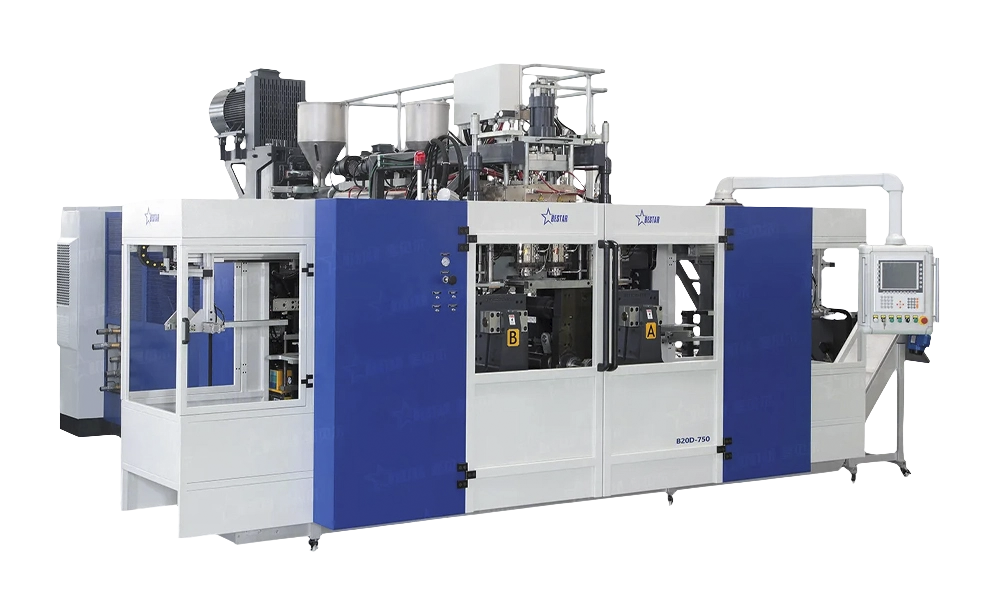
In extrusion blow molding, a continuous or intermittent extruder melts thermoplastic resin and forces it through a die head to form a hollow tube of molten plastic called a parison. The parison is captured between two mold halves, and compressed air is injected to expand the molten tube against the mold cavity walls, forming the container shape. After cooling, the mold opens and the finished container is ejected. EBM is the dominant process for HDPE, PP, and PVC containers used in food applications — including milk jugs, juice bottles, condiment containers, and wide-mouth food jars. It handles resins that are not suitable for stretch blow molding, accommodates complex handle-integrated geometries, and is available in single-layer and co-extrusion configurations for multilayer barrier containers. EBM machines range from simple single-station shuttle machines for small production volumes to high-output rotary wheel machines producing thousands of containers per hour.
Injection Stretch Blow Molding (ISBM)
Injection stretch blow molding is the process used to produce virtually all PET bottles for carbonated soft drinks, water, juice, sports drinks, and edible oils. The process has two stages: first, a preform is injection-molded from PET resin with precise wall thickness distribution; then the preform is reheated to its orientation temperature and stretch-blown — simultaneously stretched axially by a stretch rod and radially by high-pressure air — into the final bottle shape. The biaxial orientation imparted by the stretching process dramatically improves the PET's barrier properties, clarity, and mechanical strength, enabling the thin-wall, high-clarity bottles that define modern beverage packaging. ISBM machines are available in single-stage configurations (where injection molding and blow molding occur in the same machine in one continuous cycle) and two-stage configurations (where preforms are injection-molded separately and blown on a dedicated reheat stretch blow molding machine). Two-stage systems dominate high-volume beverage production because they allow dedicated optimization of each stage and significantly higher output rates.
Injection Blow Molding (IBM)
Injection blow molding is used for smaller, precision containers such as pharmaceutical bottles, cosmetic containers, and small food packaging. In IBM, a preform is injection-molded around a metal core rod, then transferred while still hot to a blow station where it is inflated into the final container shape. Unlike ISBM, there is no stretching step, so IBM does not impart biaxial orientation — this limits the process to smaller containers where the inherent properties of the resin (typically PET, PP, or HDPE) are sufficient without orientation enhancement. IBM is valued for its dimensional precision, absence of bottom weld lines, and ability to produce bottles with very consistent wall thickness — properties that are important for child-resistant closures, tamper-evident packaging, and containers requiring precise volume accuracy.
Key Machine Types for Food and Beverage Applications
Within each blow molding process category, machines are available in different configurations that directly affect output capacity, footprint, changeover flexibility, and capital cost. Matching the machine configuration to the production requirements is as important as selecting the correct process technology.
| Machine Type | Process | Output Range | Best For |
| Linear shuttle EBM | EBM | 500–5,000 containers/hr | HDPE/PP food containers, mid-volume |
| Rotary wheel EBM | EBM | 5,000–30,000+ containers/hr | High-volume milk, juice, HDPE bottles |
| Single-stage ISBM | ISBM | 1,000–8,000 bottles/hr | Wide-mouth PET jars, specialty shapes |
| Two-stage reheat blow (RHB) | ISBM | 10,000–90,000+ bottles/hr | PET water, CSD, juice, edible oil |
| Co-extrusion EBM | EBM | 500–8,000 containers/hr | Multilayer barrier containers, sauces, condiments |
| Hot-fill ISBM | ISBM | 5,000–25,000 bottles/hr | Juice, tea, isotonic drinks filled hot |
Food-Grade Compliance and Hygiene Design Requirements
For food and beverage applications, blow molding machine design must meet hygiene and food safety requirements that go beyond what is necessary for non-food industrial applications. This is a non-negotiable aspect of equipment specification that must be addressed from the outset of the procurement process, not as an afterthought.
All machine surfaces and components that come into contact with the container interior during production — blow pins, stretch rods, air circuits, and mold cavity surfaces — must be manufactured from food-grade materials and designed for effective cleaning and sanitization. Stainless steel (316L grade) is the standard material for all contact surfaces, with electropolished finishes that minimize bacterial adhesion and facilitate cleaning. Dead zones in air circuits where moisture can accumulate and support microbial growth must be eliminated through hygienic circuit design with positive drainage and sterilizable components.
For aseptic and ultra-clean applications — such as still water, milk, and sensitive juice products filled without preservatives — the blow molding machine must be integrated with or designed to interface with a sterile air supply system, UV or H₂O₂ decontamination of preforms and molds, and cleanroom-compatible enclosures. Leading machine manufacturers including Krones, Sidel, KHS, and Nissei ASB offer dedicated aseptic blow molding platforms specifically engineered for these demanding applications, with validated clean-in-place (CIP) and sterilization-in-place (SIP) cycles that meet FDA, EFSA, and international food safety authority requirements.
Critical Technical Specifications to Evaluate
When comparing blow molding machines from different manufacturers, the following technical specifications have the greatest direct impact on production performance, operating cost, and product quality. Each parameter should be requested and verified with reference to specific production conditions — not just peak or ideal-case datasheet values.
- Output rate and cavity count: Output is expressed in containers per hour (CPH) and depends on cycle time, number of cavities per mold, and machine uptime. For two-stage PET blow molding machines, output is also affected by the number of blowing stations and preform pitch. Always request guaranteed output at your specific container weight and volume — a machine rated at 20,000 CPH for a 500ml bottle will produce significantly fewer containers per hour for a 2-liter bottle of the same design.
- Blowing pressure and air consumption: PET stretch blow molding requires high-pressure air — typically 35–40 bar for the final blowing phase — which is one of the largest energy costs in blow molding operations. Modern machines incorporate high-pressure air recovery systems that capture and recycle the blowing air from each cycle, reducing compressed air consumption by 20–40% compared to machines without recovery. For high-volume operations, this efficiency difference translates into significant annual energy cost savings.
- Preform heating uniformity (ISBM): In reheat stretch blow molding, the quality and consistency of preform heating directly determines bottle quality. Infrared lamp arrays with independent zone control, rotating preform carriers, and closed-loop temperature monitoring systems produce more consistent heating profiles than simpler fixed-lamp configurations. Request wall thickness distribution data on sample bottles produced at full production speed to verify heating uniformity before equipment acceptance.
- Mold changeover time: For operations producing multiple SKUs on the same machine, mold changeover time is a critical productivity factor. Quick-change mold systems with standardized fixing points, integrated water connections, and lifting fixtures reduce changeover time from several hours to under 30 minutes on modern machines — a capability that significantly improves scheduling flexibility and reduces lost production time between production runs.
- Parison programming (EBM): For EBM machines producing containers with varying wall thickness requirements — such as bottles with handles, ergonomic grip zones, or complex base geometries — parison programming capability allows the extruder die gap to be varied dynamically during each cycle, controlling wall thickness distribution in the final container. Machines with high-resolution parison programming (100 or more control points per cycle) provide significantly better material distribution control than machines with limited programming capability.
- Reject and quality monitoring systems: Integrated vision systems, leak detection stations, and weight monitoring cells are essential for food and beverage production lines where defective containers reaching the filling line cause line stoppages, product waste, and potential food safety incidents. Specify whether these systems are integrated in the machine manufacturer's scope or require third-party integration, and verify their detection reliability at full production speed.
Integration With Filling and Packaging Lines
In modern food and beverage production, blow molding machines are rarely standalone units — they are integrated into complete production lines that include fillers, cappers, labelers, and secondary packaging equipment. The degree of integration between the blow molder and the downstream line directly affects production efficiency, contamination risk, and operational complexity.
Blowing-filling-capping (BFC) monoblock systems — in which the blow molding machine, filler, and capper are mechanically linked in a single machine frame operating under a shared cleanroom enclosure — represent the highest level of integration and are increasingly specified for water, juice, and sensitive beverage applications. BFC monoblocks eliminate the conveyor transfer between blowing and filling, which is a major source of container contamination in conventional separate-machine lines. They also reduce the machine footprint significantly and eliminate the need for empty container buffer systems. Leading manufacturers offer BFC platforms capable of producing, filling, and capping up to 90,000 containers per hour in a single, compact unit — a remarkable concentration of capability that represents the current state of the art in high-speed beverage packaging.
For operations where separate blowing and filling machines are preferred — typically when production flexibility across multiple filling lines or product types is required — the interface between the blow molder and the downstream line must be carefully designed. Air conveyors, buffer spirals, and container handling systems must be compatible with the blow molder's output rate and container geometry, and the control system integration must enable coordinated line speed adjustments, upstream-downstream communication for fault responses, and centralized production data collection for OEE monitoring.
Total Cost of Ownership and Return on Investment Considerations
The purchase price of a blow molding machine represents only a fraction of its total cost over a typical 15–20 year operational life. Procurement decisions made purely on initial capital cost frequently result in higher total costs when energy consumption, maintenance requirements, spare parts availability, and production efficiency are properly accounted for.
- Energy cost per container: Calculate energy consumption (kWh per 1,000 containers) from the manufacturer's data and multiply by your local energy cost and annual production volume. A machine that costs 15% more but consumes 25% less energy will typically deliver a lower total cost over a 10-year production horizon in high-volume operations.
- Material savings from weight reduction: Advanced blow molding machines with precise process control enable lightweighting of containers — reducing resin content per bottle by 5–15% compared to older or less precise equipment. At high production volumes, resin savings from lightweighting frequently represent the largest single cost reduction opportunity and can justify machine upgrades with payback periods of 2–4 years.
- Spare parts and service availability: Confirm that the machine manufacturer has a regional service presence with stocked spare parts available within acceptable lead times for your location. Machines from manufacturers without local service support can experience extended downtime during critical component failures, with replacement parts taking weeks to arrive from overseas manufacturing facilities.
- Scalability and future-proofing: Evaluate whether the machine platform can be upgraded as your production volumes grow — through additional blowing stations, higher-output preform handling systems, or extended automation capabilities. Platforms designed for modular expansion provide a lower-risk capital investment path than machines that require full replacement to increase capacity.