


 English


Introduction to PETG Blow Molding
What is PETG?
PETG (Polyethylene Terephthalate Glycol) is a type of thermoplastic polyester, known for its excellent clarity, ...
Content
- 1 What Is a Food Beverage Blow Molding Machine and How Does It Work?
- 2 Three Main Types of Blow Molding Technologies Used in Food and Beverage
- 3 Critical Technical Specifications to Evaluate When Purchasing
- 4 Food Safety and Hygiene Design Requirements
- 5 Integration with Filling and Packaging Lines
- 6 Energy Efficiency and Sustainability Considerations
- 7 Key Questions to Ask Suppliers Before Making a Purchase Decision
What Is a Food Beverage Blow Molding Machine and How Does It Work?
A food beverage blow molding machine is an industrial system used to manufacture hollow plastic containers — primarily bottles, jars, and jugs — intended for packaging liquid food products such as water, juice, carbonated soft drinks, dairy beverages, edible oils, and condiments. The machine takes a plastic preform or parison and uses pressurized air to inflate the heated material inside a mold cavity, forming it into the precise shape and volume required by the container design. This process is repeated at high speed across multiple cavities simultaneously, enabling continuous high-volume bottle production that feeds directly into filling and capping lines in modern beverage manufacturing facilities.
The core operating principle involves three stages: heating the plastic material to its optimal forming temperature, stretching and blowing it into the mold under controlled air pressure, and cooling the formed container sufficiently for ejection without deformation. The speed and precision at which these three stages are executed determine the machine's output capacity, container quality consistency, and energy efficiency. In food and beverage applications, these parameters carry additional weight because container dimensional accuracy directly affects filling accuracy, cap seal integrity, and label application quality on downstream packaging lines.
Three Main Types of Blow Molding Technologies Used in Food and Beverage
The food and beverage packaging industry uses three distinct blow molding processes, each suited to different container geometries, plastic materials, and production volume requirements. Understanding the technical differences between these processes is essential for selecting a machine that matches both the container design and the production economics of a specific bottling operation.
Stretch Blow Molding (SBM)
Stretch blow molding is the dominant process for manufacturing PET bottles used in water, carbonated beverages, juice, and ready-to-drink tea and coffee products. In this process, an injection-molded PET preform is reheated to between 90°C and 120°C, then mechanically stretched lengthwise by a stretch rod while simultaneously being inflated radially by high-pressure air at 30–40 bar. This biaxial orientation of the PET polymer chains significantly increases the material's tensile strength, barrier properties, and clarity compared to non-oriented PET, allowing manufacturers to use less material per bottle while maintaining structural performance. Modern linear and rotary SBM machines can produce from 1,000 to over 80,000 bottles per hour depending on the number of cavities and the container volume.
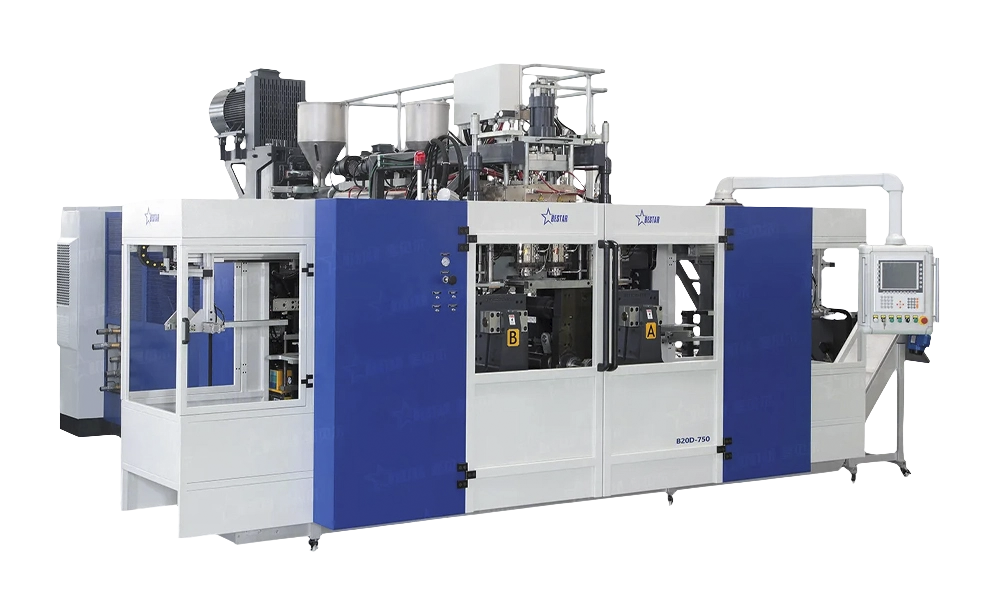
Extrusion Blow Molding (EBM)
Extrusion blow molding is used for containers made from HDPE, PP, and LDPE — materials commonly used for milk bottles, edible oil containers, juice jugs, and dairy product packaging. In EBM, molten plastic is continuously extruded as a hollow tube (parison) which is then captured by a two-part mold, inflated with low-pressure air (typically 5–10 bar), and cooled before ejection. EBM machines excel at producing containers with handles, non-round cross-sections, and wide necks — geometries that are difficult or impossible to achieve with stretch blow molding. Accumulator head EBM machines are used for very large containers such as 5-liter and 10-liter water jugs or bulk edible oil containers.
Injection Blow Molding (IBM)
Injection blow molding combines injection molding and blow molding in a single integrated machine. The plastic is first injection-molded around a core rod to form a thick-walled preform with a finished neck, which is then transferred to a blow station where it is inflated into the final container shape. IBM produces containers with very precise neck dimensions and excellent wall thickness uniformity, making it the preferred process for small pharmaceutical-style bottles, single-serve food containers, and specialty beverage packaging where neck finish accuracy is critical for tamper-evident closure systems. Production volumes are lower than SBM or EBM, but scrap rates are minimal because there is no parison trimming waste.
Critical Technical Specifications to Evaluate When Purchasing
When evaluating food beverage blow molding machines from different manufacturers, the specification sheet contains numerous technical parameters. Not all of these carry equal weight for a given application, and knowing which specifications to prioritize prevents costly mismatches between machine capability and production requirements.
| Specification | What It Means | Why It Matters |
| Number of Cavities | Mold stations per machine cycle | Directly determines output per hour |
| Output Rate (BPH) | Bottles produced per hour at rated speed | Must match filling line capacity |
| Container Volume Range | Min–max bottle size the machine handles | Determines SKU flexibility |
| Blowing Pressure | Air pressure used during bottle forming | Affects wall thickness and material distribution |
| Heating Power (kW) | Energy used in preform heating ovens | Key driver of operating energy cost |
| Mold Change Time | Time required to switch container formats | Critical for multi-SKU production schedules |
| Neck Finish Compatibility | PCO, BPF, Alaska, or custom neck standards | Must align with cap and closure supplier specs |
Food Safety and Hygiene Design Requirements
Food and beverage blow molding machines operate in environments subject to strict hygiene regulations, and the machine's mechanical and structural design must facilitate cleaning, contamination prevention, and compliance with food safety standards. This dimension of machine selection is frequently underweighted by buyers focused primarily on output speed and unit cost, but it has significant implications for audit compliance, product safety liability, and the total cost of maintaining hygienic production conditions over the machine's service life.
- Clean Room Compatibility: High-care beverage filling environments, particularly those processing juice, dairy, and still water for sensitive markets, often require blow molding machines installed in ISO Class 7 or Class 8 clean rooms. The machine's external surfaces, cable management, and lubrication systems must be designed to minimize particle generation and allow effective room sanitization without damaging sensitive components.
- Aseptic Blow Molding: For hot-fill and cold aseptic filling lines, integrated aseptic blow-fill-seal (BFS) or aseptic blow molding systems use hydrogen peroxide vapor or UV-C sterilization of the formed container interior immediately after blowing and before transfer to the filling station. These systems eliminate the bottle rinser stage in conventional lines and significantly reduce the risk of post-blow contamination in sensitive products.
- Stainless Steel Contact Surfaces: All surfaces of the machine that could potentially contact formed containers or preforms should be manufactured from food-grade stainless steel (minimum 304 grade, preferably 316 in humid environments) or approved engineering plastics. Zinc alloy, cadmium-plated, or unprotected carbon steel components have no place in food beverage blow molding equipment.
- Lubrication-Free or Food-Grade Lubrication: Mechanical components in the bottle transfer, gripper, and conveyor systems should use either lubrication-free bearings and bushings or food-grade lubricants certified to NSF H1 standard, which permits incidental contact with food packaging materials without posing a food safety risk.
Integration with Filling and Packaging Lines
In modern beverage manufacturing, the blow molding machine rarely operates as a standalone unit. The trend toward integrated blow-fill-cap (BFC) systems — where bottle blowing, filling, and capping are performed in a single synchronized block — has accelerated significantly over the past decade, driven by the dual objectives of minimizing bottle contamination risk and reducing factory floor space requirements. In a fully integrated BFC block, the blow molder output is connected directly to the filler infeed via a synchronized transfer starwheel system operating at matched speeds, eliminating the bottle conveyor section between machines and removing the largest potential contamination exposure point in the bottling process.
For lines where integrated BFC is not practical — such as multi-product facilities where the same blow molder supplies bottles to several different filling lines — bottles are conveyed by air conveyor from the blow molder output to an intermediate bottle accumulation table or storage buffer before being fed to the filler. Air conveyors use a stream of filtered, pressurized air to transport bottles by their neck ring at high speed with minimal mechanical contact, preserving container hygiene during transit. The blow molder's output speed must be balanced against the filler's rated speed plus a buffer margin to prevent starvation of the filling line during blow molder format changes or brief maintenance interventions.
Energy Efficiency and Sustainability Considerations
Energy consumption is one of the most significant operational cost drivers for blow molding in high-volume beverage production. A rotary SBM machine producing 40,000 bottles per hour of 500ml PET water bottles may consume 150–250 kW of electrical power, with the preform heating ovens accounting for 60–70% of total machine energy draw. Modern machine designs have introduced several technologies that substantially reduce energy consumption per bottle produced compared to machines from earlier generations.
- Near-Infrared (NIR) Oven Efficiency: Advanced NIR lamp oven systems with individual lamp power control and reflector optimization can reduce preform heating energy by 15–25% compared to conventional halogen lamp ovens, while also improving temperature uniformity across the preform wall for more consistent bottle weight distribution.
- Air Recycling Systems: High-pressure blowing air at 30–40 bar represents a significant energy investment. Air recycling valves capture the residual pressurized air from each blown bottle at the end of the blowing cycle and redirect it to the pre-blowing stage of the next cycle, reducing compressor energy consumption by up to 30% in well-designed systems.
- Lightweighting Capability: Machines equipped with precise servo-controlled stretch rod positioning and advanced blowing valve timing can reliably produce bottles at the lower end of the material weight specification, enabling container lightweighting programs that reduce PET consumption per bottle by 5–15% — a combined material cost and sustainability benefit that compounds significantly at high production volumes.
- rPET Compatibility: As regulatory pressure and brand sustainability commitments drive increased use of recycled PET (rPET) content in beverage bottles, machines must be capable of processing preforms with varying rPET content — up to 100% in some markets — without compromising output quality or speed. rPET requires adjusted heating profiles due to its different intrinsic viscosity and thermal behavior compared to virgin PET, and machines with adaptive oven control systems handle this variability more reliably than fixed-parameter designs.
Key Questions to Ask Suppliers Before Making a Purchase Decision
Purchasing a food beverage blow molding machine is a capital investment that will shape production capability for ten to twenty years. The supplier selection and commercial negotiation process should therefore be approached with the same rigor as the technical specification process. Beyond the machine's stated technical parameters, the following practical questions help reveal the true total cost of ownership and the supplier's long-term support capability.
- What is the guaranteed output rate under production conditions, and what is the basis for the OEE (Overall Equipment Effectiveness) figure quoted? Rated speed and actual achievable speed under real production conditions with mold changes, minor stops, and quality rejects factored in can differ substantially. Request a performance guarantee with clearly defined measurement conditions.
- What is the lead time for spare parts, and does the supplier maintain a regional spare parts warehouse? Blow molding machines in continuous 24/7 beverage production cannot tolerate multi-week spare parts lead times. Confirm that critical wear parts — blowing valves, transfer grippers, oven lamps, stretch rods — are available from regional stock within 24–48 hours.
- Does the machine support remote diagnostic access, and what cybersecurity measures protect the remote connection? Remote monitoring and diagnostics have become standard expectations for modern blow molding equipment. Verify that the system uses encrypted connections and role-based access controls to prevent unauthorized machine access through the remote service portal.
- What operator training and commissioning support is included in the purchase price, and what ongoing technical training programs are available? Machine performance is heavily operator-dependent. Suppliers who invest in comprehensive commissioning, operator certification training, and ongoing technical education programs deliver measurably better long-term OEE outcomes for their customers than those who treat training as an afterthought.
