


 English


Introduction to PETG Blow Molding
What is PETG?
PETG (Polyethylene Terephthalate Glycol) is a type of thermoplastic polyester, known for its excellent clarity, ...
Content
- 1 What Is a Bottle Blow Molding Machine for 100ML to 2L Containers?
- 2 Core Blow Molding Processes Used in This Size Range
- 3 Key Technical Specifications to Evaluate
- 4 Machine Configurations: Hydraulic vs All-Electric
- 5 Mold Design and Cavity Configuration
- 6 Applications and Industries Served
- 7 Control Systems and Process Monitoring
- 8 How to Select the Right Machine for Your Production Requirements
- 9 Conclusion
What Is a Bottle Blow Molding Machine for 100ML to 2L Containers?
A bottle blow molding machine in the 100ML to 2L capacity range is a piece of industrial equipment designed to produce hollow plastic bottles and containers within this specific volume bracket. This size range covers one of the most commercially significant segments of plastic packaging — encompassing personal care bottles, pharmaceutical containers, beverage bottles, condiment jars, household chemical containers, and a wide variety of food-grade packaging formats. Machines in this category are engineered to produce high volumes of dimensionally consistent, thin-walled containers at competitive cycle times, making them the production backbone of industries from cosmetics and pharmaceuticals to food and beverage.
The 100ML to 2L range is notable because it demands a careful balance between precision and throughput. At 100ML, containers are small enough that wall thickness consistency, neck finish accuracy, and optical clarity (for transparent bottles) are critical quality parameters. At 2L, the machine must generate sufficient blow pressure, clamp force, and parison control to produce structurally sound containers with even wall distribution. Understanding how these machines work, what differentiates their technical configurations, and how to select the right model for a given production requirement is essential for packaging engineers, production managers, and procurement teams investing in bottle manufacturing capacity.
Core Blow Molding Processes Used in This Size Range
Bottles in the 100ML to 2L range are produced using two primary blow molding processes, each suited to different resin types, bottle geometries, and production volumes. Selecting the correct process is the foundational decision in specifying a blow molding machine.
Extrusion Blow Molding (EBM)
In extrusion blow molding, a continuous or intermittent extruder melts plastic resin and extrudes it downward through an annular die to form a hollow tube called a parison. The mold closes around the parison, pinching and sealing one end, and compressed air is injected through the die or a blow pin to inflate the parison against the cooled mold cavity walls. After sufficient cooling, the mold opens and the bottle is ejected, with excess plastic (flash) at the pinch-off zones trimmed away. EBM is well suited to polyethylene (HDPE, LDPE), polypropylene, and PVC resins, and is particularly efficient for irregularly shaped containers, handled bottles, and multi-layer barrier packaging within the 100ML to 2L range. It excels at producing bottles with integrated handles or offset necks that cannot be made by stretch blow molding.
Injection Stretch Blow Molding (ISBM)
Injection stretch blow molding is the dominant process for producing PET (polyethylene terephthalate) bottles in the 100ML to 2L range — the format used for carbonated soft drinks, water, juices, and a wide range of food and personal care products. In ISBM, a precisely injection-molded preform — a thick-walled test-tube-shaped precursor with a finished neck finish — is heated to its stretch orientation temperature and then simultaneously stretched axially by a stretch rod and inflated radially by high-pressure air (typically 35–40 bar) to fill the bottle mold cavity. The biaxial orientation induced by this process dramatically improves the PET's mechanical properties, barrier performance, and optical clarity compared to simple blow molding. ISBM machines operate in either one-stage (preform injection and bottle blowing in a single machine) or two-stage (separate injection molding of preforms and standalone reheat stretch blow molding) configurations.
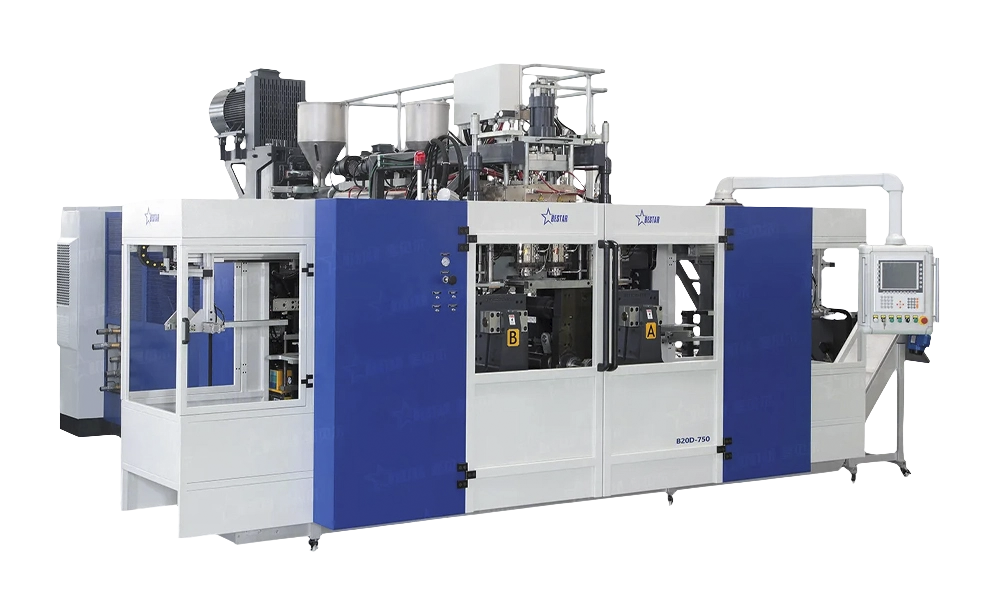
Key Technical Specifications to Evaluate
When comparing blow molding machines for the 100ML to 2L range, a set of core technical parameters defines the machine's capability, productivity, and suitability for specific applications. These specifications should be systematically evaluated against production requirements before purchase.
| Parameter | EBM Typical Range | ISBM Typical Range |
| Container volume range | 50ML–5L | 100ML–2L (standard) |
| Number of cavities | 1–6 (standard) | 2–16 (reheat SBM) |
| Output per hour | 300–3,000 bottles/hr | 1,000–20,000+ bottles/hr |
| Clamp force | 10–100 kN | 30–200 kN |
| Compatible resins | HDPE, LDPE, PP, PVC, PA | PET, PP (1-stage) |
| Blow pressure | 6–10 bar | 35–40 bar (PET) |
| Drive system | Hydraulic or all-electric | All-electric preferred |
Machine Configurations: Hydraulic vs All-Electric
Blow molding machines in the 100ML to 2L range are available in both hydraulic and all-electric drive configurations, and the choice between them significantly affects operating cost, precision, and maintenance requirements.
Hydraulic Drive Machines
Hydraulic machines use a central hydraulic power unit to drive mold clamping, parison extrusion, and other machine motions. They are well established, mechanically robust, and capable of generating high clamp forces at relatively low capital cost. However, hydraulic systems consume power continuously while the pump is running — even during non-productive phases of the cycle — and require regular hydraulic oil maintenance, filtration monitoring, and seal replacement. Oil leaks present a contamination risk in food and pharmaceutical production environments. For medium to high volume production of HDPE and PP bottles where absolute positioning precision is less critical, hydraulic machines remain a cost-effective choice.
All-Electric Drive Machines
All-electric blow molding machines replace hydraulic actuators with servo motors driving ball screws or direct-drive mechanisms for each machine axis independently. This delivers several important advantages: energy consumption is reduced by 30–60% compared to equivalent hydraulic machines because motors operate only when movement is required; positioning repeatability is significantly higher, improving bottle weight consistency and wall thickness distribution; and there is no hydraulic oil in the machine, eliminating contamination risk and simplifying maintenance. All-electric machines are increasingly preferred in pharmaceutical, food-grade, and cleanroom production environments, and their higher precision makes them particularly well suited to producing small-volume containers in the 100ML to 500ML range where tight dimensional tolerances are required.
Mold Design and Cavity Configuration
The mold is the component that defines the final shape, surface quality, and dimensional accuracy of the bottle. For the 100ML to 2L range, molds are typically machined from aluminum alloy (for faster cycle times due to better thermal conductivity and lighter weight for rapid mold changes) or steel (for higher durability in very high volume production). The number of cavities in the mold directly determines the machine's output rate: a 4-cavity mold running a 15-second cycle produces four times as many bottles per hour as a single-cavity mold on the same machine.
For EBM machines, mold cooling channel design is critical — inadequate or uneven cooling leads to inconsistent bottle wall thickness, warpage, or extended cycle times. For ISBM machines, the blow mold must be designed to withstand the high blow pressures (up to 40 bar) required for PET orientation without distortion, and the stretch rod travel must be precisely matched to the preform and bottle geometry to achieve proper biaxial orientation throughout the bottle body. Mold changeover time — the time required to swap molds for a different bottle format — is an important operational consideration for producers running multiple SKUs on the same machine, and quick-change mold mounting systems can reduce changeover from several hours to under 30 minutes on modern machines.
Applications and Industries Served
Machines producing bottles in the 100ML to 2L range serve an exceptionally broad spectrum of end markets. The volume range aligns directly with the most common consumer and commercial packaging formats across multiple industries:
- Beverage industry: PET bottles for still and carbonated water, carbonated soft drinks, juices, energy drinks, and ready-to-drink teas are produced in enormous volumes using high-speed reheat stretch blow molding machines. The 500ML and 1.5L formats are the global standard for single-serve and multi-serve beverage consumption, driving some of the highest-output machine configurations in this class.
- Personal care and cosmetics: Shampoo, conditioner, body wash, lotion, and liquid soap bottles — typically in HDPE or PET — are produced in the 100ML to 1L range. These applications often require containers with complex shapes, textured surfaces, or custom colors that differentiate products on retail shelves.
- Pharmaceutical and healthcare: Syrup bottles, tablet containers, nasal spray bottles, and liquid supplement packaging in the 100ML to 500ML range require exacting dimensional precision, tight neck finish tolerances for closure compatibility, and full traceability of production parameters — driving adoption of all-electric machines with advanced process monitoring in this sector.
- Food packaging: Cooking oil, vinegar, soy sauce, ketchup, mayonnaise, and other condiment bottles in the 250ML to 2L range are typically produced in PET or HDPE, with requirements for clarity, food safety compliance, and barrier performance against oxygen ingress.
- Household chemicals: Cleaning product bottles, detergent containers, and disinfectant packaging in HDPE — often with integral handles in the 500ML to 2L range — are efficiently produced by EBM machines with multi-cavity head configurations.
Control Systems and Process Monitoring
Modern blow molding machines for the 100ML to 2L range are equipped with sophisticated PLC-based or PC-based control systems that manage and monitor all process parameters in real time. Key control system features that distinguish quality machines include:
- Parison programming (EBM): Wall thickness distribution in the extruded parison can be programmed across up to 100 or more points along the parison length using a parison controller, allowing wall thickness to be precisely tailored to compensate for the different degrees of stretching that occur at different zones of the bottle during blowing.
- Preform heating control (ISBM): Reheat stretch blow molding machines use infrared oven arrays with individually controllable lamp zones to heat preforms to a precise and uniform temperature profile before blowing. Advanced closed-loop pyrometer systems measure actual preform surface temperature and adjust lamp power in real time to compensate for ambient temperature variation or preform batch differences.
- Statistical process control (SPC) integration: Higher-end machines integrate online weight checking, vision inspection systems, and leak testing stations that sample every bottle or a statistical subset, automatically rejecting out-of-specification containers and logging production quality data for traceability and continuous improvement purposes.
- Remote monitoring and Industry 4.0 connectivity: OPC-UA, MQTT, and proprietary IoT protocols enable machine performance data — OEE, cycle time, reject rates, energy consumption — to be transmitted to factory MES or cloud platforms for real-time production management and predictive maintenance programs.
How to Select the Right Machine for Your Production Requirements
Selecting the optimal blow molding machine for 100ML to 2L bottle production requires a structured evaluation process that matches machine capabilities to specific production, quality, and operational requirements. The following framework guides this decision:
- Define the resin and bottle format: The primary choice between EBM and ISBM is driven by resin type and bottle geometry. PET bottles — especially for beverages and clear containers — require ISBM. HDPE, PP, or PVC bottles with handles, offset necks, or irregular shapes are best produced by EBM. Confirm the target bottle weight, wall thickness, and neck finish specification before engaging machine suppliers.
- Calculate required output capacity: Determine the required annual production volume, divide by planned operating hours (accounting for realistic OEE of 70–85%), and calculate the minimum bottles per hour the machine must produce. Factor in production of multiple SKUs and the time lost to mold changeovers when sizing machine capacity.
- Assess product quality requirements: Pharmaceutical and food applications typically require all-electric machines for precision and contamination control. Commodity packaging in less regulated sectors may be well served by hydraulic machines at lower capital cost. Define wall thickness tolerance, weight variation limits, and visual inspection standards before specifying the machine grade.
- Evaluate total cost of ownership: Machine purchase price is only one component of total cost. Energy consumption, compressed air demand (particularly significant for high-pressure PET blowing), mold costs, spare parts availability, and local service support all contribute to the true 10-year cost of the investment. Request detailed energy consumption data at rated output and verify local service network capability before committing to a supplier.
- Future-proof for format flexibility: If the product portfolio is likely to expand or change, select a machine platform that supports a wide range of mold sizes and bottle neck finishes without major mechanical modifications, and verify that the control system supports recipe management for rapid format changeover.
Conclusion
Blow molding machines for the 100ML to 2L bottle range represent one of the most commercially important categories of plastic processing equipment, serving the packaging needs of the global beverage, personal care, pharmaceutical, and food industries. The choice between extrusion blow molding and injection stretch blow molding, the decision between hydraulic and all-electric drives, the selection of cavity count and mold configuration, and the evaluation of control system sophistication all combine to determine whether a machine investment delivers the productivity, quality, and operating cost performance that modern competitive manufacturing demands. By applying the structured evaluation framework outlined in this guide and engaging experienced machine suppliers with proven track records in the target application sector, production teams can confidently specify and commission blow molding equipment that delivers sustainable competitive advantage.
