


 English


Introduction to PETG Blow Molding
What is PETG?
PETG (Polyethylene Terephthalate Glycol) is a type of thermoplastic polyester, known for its excellent clarity, ...
Content
- 1 Why the 1.5L Milk Bottle Format Drives Specific Machine Requirements
- 2 Blow Molding Process Types Used for 1.5L Milk Bottle Production
- 3 Key Technical Specifications of EBM Machines for 1.5L Milk Bottles
- 4 Parison Programming and Wall Thickness Control for 1.5L Bottles
- 5 Mold Design Considerations for 1.5L Milk Bottle Production
- 6 HDPE Material Selection and Processing Parameters for Milk Bottles
- 7 Downstream Equipment Integration for a Complete 1.5L Milk Bottle Production Line
- 8 Evaluating Machine Suppliers and Total Cost of Ownership
Why the 1.5L Milk Bottle Format Drives Specific Machine Requirements
The 1.5-liter milk bottle occupies a distinct position in dairy packaging — large enough to serve family consumption needs, yet still manageable for retail shelf display and consumer handling. This volume format places specific demands on the blow molding machine used to produce it. Unlike small-format bottles where cycle time and cavity count dominate the economics, the 1.5L bottle requires careful attention to wall thickness distribution, base integrity, and neck finish precision, since the larger volume means more material is in motion during the blowing phase and any inconsistency in parison programming or blow pressure results in visible wall thickness variation that affects structural performance and aesthetic quality.
Milk bottles in the 1.5L format are predominantly produced from high-density polyethylene (HDPE), which provides the combination of food safety compliance, stiffness, environmental stress crack resistance (ESCR), and compatibility with high-speed filling lines that dairy processors require. The opacity of HDPE also provides inherent light protection for the milk, reducing riboflavin degradation without requiring additional light-barrier coatings or outer sleeves. A smaller proportion of the market uses polypropylene (PP) for heat-fillable applications or PET for clear bottles where product visibility is a marketing priority. Each material has distinct processing requirements that influence machine selection and configuration.
Blow Molding Process Types Used for 1.5L Milk Bottle Production
Two blow molding process variants are used commercially for 1.5L milk bottle production, each with distinct advantages and limitations that make them suitable for different production scales, material requirements, and capital investment profiles.
Extrusion Blow Molding (EBM)
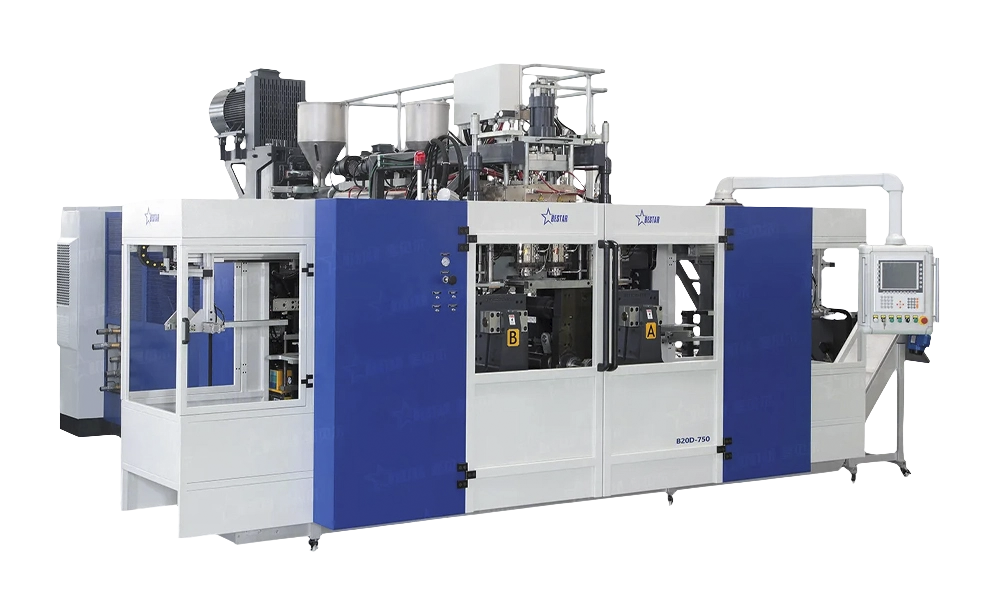
Extrusion blow molding is the dominant process for HDPE 1.5L milk bottle production worldwide. In EBM, a continuous or intermittent extruder melts the HDPE resin and forces it through an annular die head to form a hollow tubular parison. The mold closes around the parison, a blow pin is inserted, and compressed air inflates the parison against the mold cavity walls. After a defined cooling time, the mold opens and the bottle is ejected with a flash trim operation removing the pinch-off material at the base and neck. EBM machines for milk bottle production are typically configured with multiple die heads — commonly 2, 4, 6, or 8 heads — running simultaneously to maximize output per machine cycle. The intermittent extrusion variant, using an accumulator head, is favored for larger bottles and complex handle-integrated designs, while continuous extrusion with a rotating or shuttle mold system is preferred for high-speed, high-volume production of standard neck-finish bottles.
Injection Stretch Blow Molding (ISBM) for PET Variants
For 1.5L milk bottles produced in PET — primarily transparent bottles for fresh pasteurized milk or flavored dairy drinks — injection stretch blow molding is the standard process. ISBM first produces a precisely dimensioned injection-molded preform with a finished neck thread, which is then reheated and biaxially stretched and blown into the final bottle shape. ISBM delivers superior optical clarity, tighter dimensional tolerances, and higher material efficiency compared to EBM for PET, but requires significantly higher capital investment in injection mold tooling and is not suitable for HDPE at commercial scale. For dairy processors requiring opaque HDPE bottles, EBM remains the correct process choice.
Key Technical Specifications of EBM Machines for 1.5L Milk Bottles
When evaluating extrusion blow molding machines for 1.5L HDPE milk bottle production, the following technical parameters define machine capability and production economics. These specifications should be obtained and compared across candidate equipment suppliers before procurement decisions are made.
| Parameter | Typical Specification | Significance |
| Number of die heads / cavities | 2 to 8 heads | Directly determines output per cycle |
| Cycle time (1.5L HDPE) | 4 to 8 seconds | Key driver of hourly output capacity |
| Extruder screw diameter | 60 mm to 100 mm | Determines melt output capacity |
| Extruder output rate | 60 to 200 kg/hr | Must match cycle time × shot weight |
| Clamping force | 30 to 120 kN per station | Must exceed blow pressure × projected area |
| Blow air pressure | 6 to 10 bar | Determines surface replication quality |
| Parison programming points | Up to 128 points | Controls wall thickness distribution |
| Mold water cooling zones | 4 to 8 independent circuits | Enables differential cooling optimization |
| Installed electrical power | 30 to 90 kW | Affects operating cost per bottle |
Cycle time is the single most important parameter driving hourly bottle output for a given number of cavities. For a 4-cavity machine producing 1.5L HDPE bottles with a 6-second cycle time, the theoretical output is 4 × 3,600 ÷ 6 = 2,400 bottles per hour. In practice, machine efficiency — accounting for parison drop time, mold open-close time, deflashing, and minor stoppages — typically reduces actual output to 85–92% of theoretical, yielding approximately 2,040 to 2,200 bottles per hour for this configuration. Specifying machines with servo-driven mold clamps and extruder drives reduces cycle time and energy consumption simultaneously, providing both productivity and operating cost advantages over older hydraulic-only machine designs.
Parison Programming and Wall Thickness Control for 1.5L Bottles
Parison programming — the dynamic adjustment of the die gap during parison extrusion to pre-distribute material to zones that will be stretched more during blowing — is one of the most technically important capabilities of a modern EBM machine for 1.5L milk bottle production. Without parison programming, material distribution in the blown bottle is determined entirely by the geometry of the mold and the uniform parison diameter, resulting in thin walls at the extremities of the bottle that have been stretched the most and excessively thick walls at the pinch-off zones.
For a 1.5L milk bottle with a handle, shoulders, and base geometry, the parison must be programmed to deliver more material to the handle area and base corners — which see high stretch ratios during blowing — and less material to the cylindrical body section where the blow-up ratio is lower. Modern EBM machines achieve this through a parison programming system that varies the die mandrel position relative to the die bushing as the parison is extruded, creating a variable wall thickness along the parison length. Systems with 32 to 128 programmable control points provide sufficient resolution to optimize wall thickness across the full height profile of a complex 1.5L bottle geometry.
The practical outcome of effective parison programming is a bottle with more uniform wall thickness, enabling the average wall thickness — and therefore material consumption per bottle — to be reduced without compromising the minimum wall thickness at critical structural zones. For a 1.5L HDPE milk bottle with a target average wall thickness of 0.8 mm, good parison programming can reduce material consumption by 3 to 8% compared to an unprogrammed baseline, representing significant resin cost savings at high production volumes.
Mold Design Considerations for 1.5L Milk Bottle Production
The blow mold is a critical component of the 1.5L milk bottle production system, and its design directly affects bottle quality, production speed, and tooling longevity. Molds for HDPE milk bottle production are typically manufactured from aluminum alloy — most commonly 7075 or 2024 series — which offers excellent thermal conductivity for rapid cooling, machinability for precise cavity geometry, and sufficient hardness for the relatively low-pressure blow molding process. Steel molds, which offer higher durability, are used for ultra-high-volume production runs where the longer tool life justifies the higher initial cost and slower heat transfer.
Cooling Circuit Design
Mold cooling is the dominant factor limiting cycle time in HDPE blow molding. The HDPE bottle must be cooled from the melt temperature of approximately 180–200°C to a demolding temperature below 60°C before the mold can open without bottle deformation. Conformal cooling circuits — channels drilled to follow the contour of the cavity surface at a uniform distance — provide more even cooling than straight-drilled channels and reduce the temperature differential across the bottle wall that causes differential shrinkage and warpage. For 1.5L bottles with handles and complex base geometry, conformal cooling in the handle core and base insert is particularly important, as these zones have limited surface area for heat extraction relative to the material volume they contain.
Pinch-Off and Flash Management
The pinch-off geometry at the base and neck of the mold determines the quality and consistency of the weld line where the mold closes around the parison. A sharp, well-maintained pinch-off edge creates a thin, clean flash that is easy to trim and minimizes material waste. A worn or poorly designed pinch-off produces thick, uneven flash that is harder to remove and may leave residual material on the bottle base that creates instability on filling line conveyors. For high-speed production, automatic deflashing integrated into the mold or immediately downstream on a trim station is standard practice, eliminating the manual labor cost of hand deflashing.
HDPE Material Selection and Processing Parameters for Milk Bottles
Not all HDPE grades are suitable for milk bottle production. The resin must meet food contact compliance requirements under regulations such as EU Regulation 10/2011 and FDA 21 CFR 177.1520, as well as the specific processing and performance requirements of blow-molded dairy packaging. Key resin selection criteria include melt flow rate, molecular weight distribution, ESCR rating, and pigment compatibility.
- Melt flow rate (MFR): Blow molding grade HDPE for 1.5L milk bottles typically has an MFR of 0.3 to 1.0 g/10 min (measured at 190°C / 2.16 kg per ASTM D1238). Lower MFR grades have higher molecular weight, which improves ESCR and bottle toughness but requires higher extrusion temperatures and torque. Higher MFR grades process more easily but produce bottles with lower ESCR — a critical property for milk bottles that must resist stress cracking in contact with cleaning detergents on the filling line.
- Environmental stress crack resistance (ESCR): ESCR is the most application-critical mechanical property for HDPE milk bottles. The bottle must withstand contact with cleaning agents, detergent residues, and the internal stress from filling, capping, and drop impact without developing stress cracks. ESCR values for milk bottle grades are specified as F50 hours in ASTM D1693 Condition B testing, with premium grades achieving F50 values exceeding 1,000 hours.
- Titanium dioxide (TiO₂) pigmentation: White opacity in HDPE milk bottles is achieved by incorporating TiO₂ masterbatch at 3 to 6% loading. TiO₂ provides the light barrier that protects milk riboflavin content, but at high loadings it can reduce ESCR and impact resistance of the bottle wall. Pigment dispersion quality in the masterbatch is critical — poorly dispersed TiO₂ agglomerates act as stress concentrators that initiate cracking under drop impact conditions.
- Regrind incorporation: Flash and trim waste from the blow molding process can be reground and reincorporated into the extrusion feed at levels of 10 to 25% without significant degradation of bottle properties, provided the regrind is clean, uncontaminated, and not thermally degraded from multiple processing cycles. Managing regrind quality and ratio is an important aspect of production cost control in high-volume milk bottle manufacturing.
Downstream Equipment Integration for a Complete 1.5L Milk Bottle Production Line
A standalone blow molding machine produces bottles, but a complete 1.5L milk bottle production line requires a series of downstream equipment stations that handle, inspect, and convey bottles from the molding machine to the filling line or finished goods storage. Integrating this downstream equipment correctly is essential for achieving the target line efficiency and bottle quality standards required by dairy processors.
- Automatic deflashing and trimming: Rotary or reciprocating trim presses remove the base and neck flash immediately after bottle ejection. Inline deflashing eliminates manual labor and ensures consistent flash removal quality across all cavities. The trim waste is collected by a pneumatic conveyor and returned to the granulator for regrind processing.
- Leak testing: Every 1.5L milk bottle should pass through an automatic leak tester that pressurizes the bottle with air and detects pressure decay indicative of pin-holes, weld line failures, or incomplete base pinch-off. Leak testers operating at 200 to 400 bottles per minute are available for integration with high-speed multi-cavity machines, with automatic rejection of failed bottles to a quarantine chute.
- Vision inspection systems: Camera-based vision systems inspect bottle dimensions, wall thickness uniformity, surface defects, and neck finish geometry at line speed. They provide statistical process control data to the machine operator and trigger automatic rejection of out-of-specification bottles before they reach the filling line.
- Conveying and accumulation: Air conveyor systems transport bottles from the blow molding machine to the filling hall without contact with bottle surfaces, maintaining hygiene standards required for food packaging. Accumulation tables or spiral accumulators provide buffer capacity to decouple the blow molding machine from the filling line and allow independent operation during short stoppages on either piece of equipment.
Evaluating Machine Suppliers and Total Cost of Ownership
Selecting a blow molding machine for 1.5L milk bottle production involves evaluating not only the initial capital cost but the total cost of ownership over the expected 10 to 15-year machine service life. Key factors in this evaluation include energy consumption, spare parts availability and cost, mold changeover time, and the supplier's technical support capability in the buyer's geography.
Energy efficiency has become an increasingly important selection criterion as electricity costs rise globally. Servo-driven machines with energy recovery systems on the hydraulic clamping circuit consume 25 to 40% less electrical energy per kilogram of HDPE processed compared to conventional hydraulic machines of equivalent output — a saving that accumulates to significant amounts over a multi-year production horizon. Requesting guaranteed specific energy consumption data — expressed in kWh per kilogram of resin processed or kWh per 1,000 bottles — from competing suppliers enables an objective energy cost comparison that should be included in the total cost of ownership analysis alongside capital price, installation cost, and projected maintenance expenditure.
