


 English


Introduction to PETG Blow Molding
What is PETG?
PETG (Polyethylene Terephthalate Glycol) is a type of thermoplastic polyester, known for its excellent clarity, ...
Content
- 1 Why Pesticide Bottle Production Demands Specialized Blow Molding Equipment
- 2 How Extrusion Blow Molding Works for Pesticide Bottles
- 3 Resin Requirements and Machine Compatibility
- 4 Key Technical Specifications to Evaluate
- 5 Mold Design Considerations for Agrochemical Bottles
- 6 Quality Control Integration on the Production Line
- 7 Energy Efficiency and Total Cost of Ownership
- 8 Selecting a Supplier and Evaluating After-Sales Support
Why Pesticide Bottle Production Demands Specialized Blow Molding Equipment
Pesticide bottles are not ordinary packaging containers. They must withstand direct contact with highly aggressive chemical formulations including organophosphates, pyrethroids, herbicide concentrates, and emulsifiable oils, many of which would cause standard packaging to swell, crack, or leach contaminants back into the product. At the same time, these bottles must meet strict regulatory requirements for child resistance, tamper evidence, precise volumetric accuracy, and label adhesion. The combination of chemical compatibility, structural integrity, and regulatory compliance means that the blow molding machine producing these bottles must be engineered to tighter tolerances and configured with more specialized tooling than a general-purpose bottle production line.
Pesticide bottle blow molding machines are purpose-built or specifically configured extrusion blow molding systems capable of processing high-density polyethylene (HDPE), fluorinated HDPE, and occasionally polypropylene resins into bottles ranging from 50 ml agrochemical sample containers to 5-liter field application jugs. Understanding the technical requirements specific to this application is the starting point for making a sound equipment investment decision.
How Extrusion Blow Molding Works for Pesticide Bottles
The extrusion blow molding process used for pesticide bottles follows a well-established sequence, but the parameters within each stage must be precisely controlled to produce bottles that meet the demanding specifications of the agrochemical packaging market. The process begins in the extruder barrel, where resin pellets are melted by a combination of barrel heater bands and the shear heat generated by the rotating screw. The molten resin is then pushed through a die head, which forms it into a hollow tube of molten plastic called a parison. The parison hangs vertically from the die head and is captured by the mold when it closes around it.
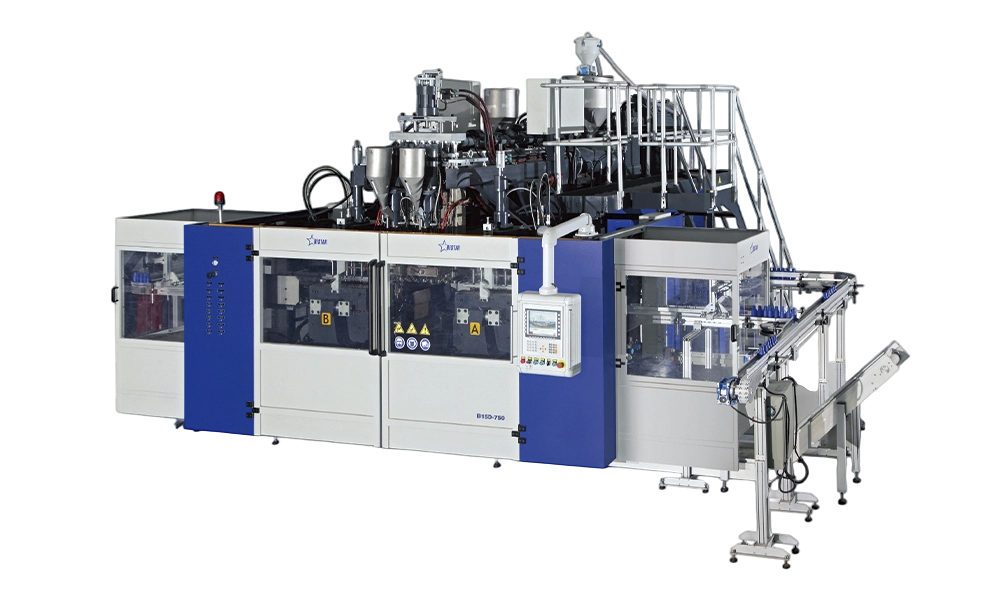
Once the mold closes, compressed air is introduced through a blow pin inserted into the open end of the parison. The air pressure inflates the molten parison outward until it contacts the cooled mold cavity walls, taking on the shape of the bottle. The mold is held closed while the bottle cools sufficiently to retain its shape, then opens to release the formed bottle. Flash, the excess plastic squeezed out at the pinch-off points where the mold closes, is trimmed either in-mold or by a separate deflashing station downstream. The entire cycle — from parison formation to bottle ejection — typically takes between 5 and 20 seconds depending on bottle size, wall thickness, and cooling efficiency.
Resin Requirements and Machine Compatibility
The choice of resin for pesticide bottles directly influences which machine configurations are required. HDPE is by far the most widely used resin for agrochemical bottles because of its excellent chemical resistance, low permeability to most pesticide solvents, ease of processing, and low cost. However, certain pesticide formulations, particularly those containing aromatic solvents or chlorinated compounds, permeate through standard HDPE at rates that are unacceptable for shelf life and safety compliance. In these cases, fluorinated HDPE bottles are required, which are produced by either post-production fluorination of standard HDPE bottles or by inline fluorination during the blow molding process.
Machines configured for inline fluorination introduce a controlled mixture of fluorine gas and nitrogen into the blow air stream during the inflation stage. This fluorinates the interior surface of the bottle as it is formed, creating a barrier layer that dramatically reduces solvent permeation without requiring a secondary processing step. Inline fluorination capability adds complexity and cost to the machine and requires specialized safety engineering including gas containment, scrubbing systems, and operator safety protocols, but it eliminates the logistics of off-site post-fluorination for producers manufacturing barrier bottles at high volumes.
Key Technical Specifications to Evaluate
When comparing pesticide bottle blow molding machines from different manufacturers, a structured evaluation of technical specifications ensures that the chosen equipment can meet current production requirements while offering room for future product development. The following table summarizes the most important parameters and their practical implications:
| Specification | Typical Range | Practical Significance |
| Bottle Capacity Range | 50 ml – 5,000 ml | Machine must cover the full bottle size range in the product portfolio without requiring major mechanical changes |
| Number of Cavities | 1 – 6 cavities | Higher cavity counts increase output per cycle but require more precise parison control and higher clamping force |
| Extruder Screw Diameter | 50 mm – 120 mm | Determines plasticizing capacity and maximum output rate; larger screws support higher production volumes |
| Clamping Force | 20 kN – 200 kN | Must exceed the force generated by blow pressure acting on the projected bottle area to prevent mold flash |
| Parison Wall Thickness Control | Up to 128-point PWDS | Programmed wall thickness variation along parison length compensates for stretch differences, ensuring uniform bottle wall thickness |
| Production Output | 500 – 3,000+ bottles/hour | Must be matched to downstream filling and labeling line capacity to avoid production bottlenecks |
| Control System | PLC with HMI touchscreen | Centralized recipe management allows rapid changeover between bottle specifications with stored process parameters |
Mold Design Considerations for Agrochemical Bottles
The mold is the most bottle-specific component of a blow molding system, and its design has a direct impact on bottle quality, cycle time, and production economics. For pesticide bottles, several mold design elements deserve particular attention beyond the standard requirements of general packaging molds.
Neck Finish Precision
Pesticide bottles frequently incorporate child-resistant closures, which require extremely precise neck finish dimensions. The thread profile, neck diameter, and out-of-roundness tolerance of the bottle neck must be held within tight limits to ensure reliable engagement with the closure mechanism. Molds for child-resistant neck finishes are typically made from beryllium copper or hardened P20 steel to maintain dimensional accuracy over millions of production cycles, and the neck area is often cooled more aggressively than the body to minimize thermal distortion during demolding.
Handle Integration
Larger pesticide containers, particularly 1-liter to 5-liter field application bottles, often incorporate integral handles formed as part of the blow molding process. Handles are created by designing a channel in the mold cavity that captures a portion of the inflated parison, forming a pinched-off tunnel through the bottle body. The handle area requires careful pinch-off geometry to produce a clean, strong weld line without thin spots that could crack under the load of a full bottle. Venting in the handle region of the mold must be carefully positioned to allow air to escape as the parison inflates into this complex geometry.
Label Panel Geometry
Pesticide regulations in most markets require comprehensive label information including active ingredients, hazard classifications, first aid instructions, and application directions. The bottle body must provide adequate flat panel area to accommodate these labels. Mold designers must balance the structural requirements of the bottle with the label area requirements, often incorporating recessed label panels that protect label edges from abrasion during transport and storage while maintaining sufficient bottle rigidity to prevent panel collapse when the bottle is squeezed during handling.
Quality Control Integration on the Production Line
Pesticide bottle production requires robust inline quality control to catch defective bottles before they reach the filling line. Bottles with pinholes, thin walls, incomplete neck formation, or excessive flash represent not only a production waste cost but also a potential safety and regulatory compliance issue if they enter the supply chain. Modern pesticide bottle blow molding lines integrate several quality control technologies directly into the production flow.
- Air Leak Testing: Every bottle is pressurized with low-pressure air through the neck and monitored for pressure decay over a set time interval. Bottles failing the pressure decay threshold are automatically rejected. This test reliably detects pinholes and incomplete pinch-off welds that would allow pesticide leakage in service.
- Weight Checking: Inline checkweighers verify that each bottle falls within the acceptable weight range for its specification. Underweight bottles indicate insufficient wall thickness in some areas, while overweight bottles suggest excessive material use. Both conditions trigger automatic rejection and can signal a process drift alert to the operator.
- Vision Inspection Systems: Camera-based vision systems inspect neck finish dimensions, flash presence, and label panel surface quality. For bottles with printed or embossed batch codes, vision systems can verify code legibility and completeness as part of the traceability requirements for agrochemical packaging.
- Wall Thickness Measurement: Ultrasonic or optical wall thickness gauges sample bottles at regular intervals to confirm that the parison programming is producing the intended thickness distribution. This data feeds back into the parison wall thickness control system to enable closed-loop process correction.
Energy Efficiency and Total Cost of Ownership
The operating cost of a pesticide bottle blow molding machine over its service life significantly exceeds its purchase price, making energy efficiency a critical factor in the total cost of ownership calculation. The two largest energy consumers on a blow molding line are the extruder drive motor and the barrel heating system. Modern machines use variable-frequency drives on the extruder motor to match energy consumption to actual production demand rather than running at full power continuously. Barrel heating systems with ceramic band heaters and insulation jackets reduce heat loss and stabilize melt temperature while consuming less energy than conventional cast aluminum heaters.
Hydraulic clamping systems, traditionally the second largest energy consumer after the extruder, are increasingly being replaced by all-electric or hybrid servo-electric clamping systems in new machine designs. All-electric clamping eliminates the hydraulic power unit entirely, reducing noise levels, eliminating hydraulic oil maintenance, and cutting clamping system energy consumption by 50 to 70 percent compared to conventional hydraulic designs. For high-volume pesticide bottle producers running machines on two or three shifts, the energy savings from all-electric or hybrid machine configurations can recover the premium purchase price within two to three years of operation.
Selecting a Supplier and Evaluating After-Sales Support
The technical specifications of a pesticide bottle blow molding machine are only part of the procurement decision. The supplier's ability to provide effective commissioning support, operator training, spare parts supply, and remote or on-site service is equally important, particularly for producers operating in regions where local technical expertise for specialized blow molding equipment may be limited. When evaluating suppliers, request references from existing customers producing similar bottle types and volumes, and verify that the supplier maintains an inventory of wear parts including screws, barrels, die heads, and hydraulic seals rather than sourcing them to order on extended lead times.
Factory acceptance testing before shipment is a standard practice that should be contractually required for any significant blow molding machine purchase. During factory acceptance testing, the machine is run producing the specified bottle types at rated output, and bottle samples are measured and tested against the agreed quality specifications. Deficiencies identified during factory testing are far less costly to correct than problems discovered after the machine has been installed and commissioned at the customer's facility. Establishing clear acceptance criteria in the purchase contract, including bottle weight tolerance, wall thickness distribution, leak test pass rate, and production output rate, protects the buyer and gives the supplier unambiguous performance targets to meet before delivery.
