


 English


Introduction to PETG Blow Molding
What is PETG?
PETG (Polyethylene Terephthalate Glycol) is a type of thermoplastic polyester, known for its excellent clarity, ...
Content
- 1 What Is a Pharmaceutical Bottle Blow Molding Machine?
- 2 Main Types of Blow Molding Processes Used in Pharmaceutical Production
- 3 Key Components of a Pharmaceutical Blow Molding Machine
- 4 GMP and Regulatory Requirements for Pharmaceutical Blow Molding Equipment
- 5 Resin Selection for Pharmaceutical Blow Molded Containers
- 6 Critical Machine Selection Criteria for Pharmaceutical Manufacturers
- 7 Maintenance Best Practices to Sustain GMP Compliance
What Is a Pharmaceutical Bottle Blow Molding Machine?
A pharmaceutical bottle blow molding machine is a specialized piece of manufacturing equipment designed to produce hollow plastic containers — including tablet bottles, syrup bottles, eye drop vials, nasal spray containers, and IV fluid bottles — that meet the strict dimensional tolerances, material purity standards, and cleanliness requirements demanded by the pharmaceutical industry. Unlike general-purpose blow molding machines used in food or consumer goods packaging, pharmaceutical-grade machines incorporate enhanced contamination controls, cleanroom-compatible designs, and validation documentation frameworks that align with Good Manufacturing Practice (GMP) regulations enforced by bodies such as the US FDA, European EMA, and China NMPA.
The core function of any blow molding machine is to take a thermoplastic resin — most commonly High-Density Polyethylene (HDPE), Polypropylene (PP), Polyethylene Terephthalate (PET), or Cyclic Olefin Copolymer (COC) — and form it into a precisely shaped bottle through a combination of heat, air pressure, and mold tooling. In pharmaceutical applications, every aspect of this process must be tightly controlled to ensure that the finished containers are free from particulates, off-gases, residual mold release agents, and dimensional defects that could affect drug stability, dosing accuracy, or patient safety.
Main Types of Blow Molding Processes Used in Pharmaceutical Production
Three primary blow molding technologies are used to produce pharmaceutical bottles, each suited to different container types, production volumes, and material requirements. Understanding the differences between these processes is fundamental to selecting the right machine for a given application.
Extrusion Blow Molding (EBM)
Extrusion blow molding is the most widely used process for producing HDPE and PP pharmaceutical bottles, particularly for tablet and capsule containers, liquid oral medication bottles, and reagent bottles. In EBM, a continuous or intermittent extruder melts the plastic resin and pushes it through a circular die to form a hollow tube of molten plastic called a parison. The mold closes around the parison, a blow pin introduces compressed air to inflate the parison against the mold cavity walls, and the part is cooled and ejected. EBM is highly productive, capable of running multi-cavity tools at high cycle rates, and accommodates a wide range of bottle sizes and neck finishes.
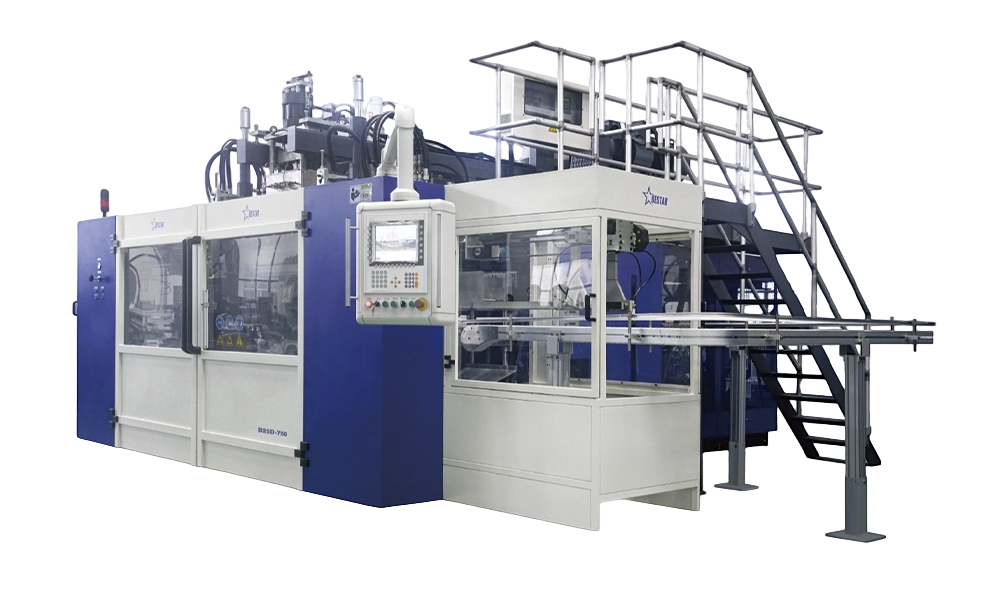
Injection Blow Molding (IBM)
Injection blow molding produces pharmaceutical containers with superior dimensional accuracy, particularly in the neck and thread area — a critical requirement for containers that must accept precision-fit closures, droppers, pumps, or child-resistant caps. In IBM, the process occurs in two stages on a rotating or indexing table: first, molten plastic is injection-molded around a steel core pin to form a preform; then the preform is transferred to a blow mold where it is inflated into the final bottle shape. IBM is preferred for small, high-precision containers such as eye drop bottles, nasal spray bottles, and oral solid dose containers where flash-free production and tight tolerances are essential.
Stretch Blow Molding (SBM)
Stretch blow molding — most commonly used with PET resin — is employed for pharmaceutical applications requiring excellent clarity, barrier properties, and lightweight construction. SBM involves stretching a preform both axially (with a stretch rod) and radially (with blow air) simultaneously, which biaxially orients the polymer chains and produces a bottle with significantly improved mechanical strength, barrier performance, and optical clarity compared to unstretched PET. This process is used for sterile water, oral liquid medications, and nutritional supplement bottles where transparency and product visibility are marketing and safety requirements. Both single-stage (where preform production and blowing occur on the same machine) and two-stage (where preforms are produced separately and reheated for blowing) SBM configurations are used in pharmaceutical production.
Key Components of a Pharmaceutical Blow Molding Machine
Pharmaceutical-grade blow molding machines share a set of core mechanical and control components, though their specific configuration varies by process type. Understanding these components helps procurement teams evaluate machine specifications and compare competing equipment options.
- Extruder or Injection Unit: Melts and conveys the plastic resin. Screw geometry, L/D ratio, and barrel temperature zoning directly affect melt quality, homogeneity, and throughput rate.
- Die Head or Hot Runner System: Distributes molten plastic evenly to form the parison or preform. Precision die design is critical for consistent wall thickness distribution in the finished bottle.
- Mold Clamping System: Opens, closes, and holds the mold under sufficient force to resist blow pressure. Pharmaceutical molds are typically machined from hardened steel or aluminum alloy and are polished to a high surface finish.
- Blow and Stretch Assembly: Introduces compressed, filtered air (and a stretch rod in SBM) to inflate the preform or parison inside the mold cavity.
- Cooling System: Circulates chilled water through the mold to solidify the bottle rapidly and maintain cycle time. Mold temperature uniformity directly affects dimensional consistency and surface quality.
- Control System (PLC/HMI): Manages all machine functions including temperature, pressure, timing, and quality monitoring. Pharmaceutical machines require 21 CFR Part 11-compliant control systems with electronic batch records and audit trails.
- Downstream Handling: Conveyors, leak testing stations, vision inspection systems, and container deflashing units integrated after the mold to ensure every bottle leaving the machine meets specification before entering the filling line.
GMP and Regulatory Requirements for Pharmaceutical Blow Molding Equipment
The pharmaceutical industry operates under stringent regulatory frameworks that impose specific requirements on manufacturing equipment, including blow molding machines. Any machine used to produce primary packaging — containers that directly contact the drug product — must be designed, installed, qualified, and operated in compliance with applicable GMP guidelines.
Critical GMP requirements that affect pharmaceutical blow molding machine specification and procurement include:
- Material Contact Compliance: All surfaces that contact molten resin or finished containers must be fabricated from materials that comply with applicable food and drug contact regulations, including FDA 21 CFR and EU Regulation 10/2011 for plastic materials in contact with food and pharmaceutical products.
- Cleanroom Compatibility: Machines intended for sterile or aseptic pharmaceutical packaging must be compatible with ISO Class 7 or Class 8 cleanroom environments, with smooth external surfaces, minimal horizontal ledges, and enclosed product contact zones to facilitate cleaning and reduce particle generation.
- Qualification Documentation: Suppliers must provide Design Qualification (DQ), Installation Qualification (IQ), Operational Qualification (OQ), and Performance Qualification (PQ) documentation packages to support the customer's validation program.
- Data Integrity and Audit Trail: Control systems must comply with 21 CFR Part 11 or EU Annex 11, providing electronic records with timestamps, user access control, and tamper-evident audit trails for all critical process parameters.
- Particulate Control: Blow air supplied to the blow station must be filtered to an appropriate cleanliness level (typically ISO 8573-1 Class 1 or better) to prevent particulate contamination of the bottle interior.
Resin Selection for Pharmaceutical Blow Molded Containers
The choice of thermoplastic resin profoundly affects the functional performance, regulatory compliance, and processing behavior of pharmaceutical blow molded containers. Each resin offers a distinct balance of properties suited to specific drug product types and packaging requirements.
| Resin | Key Properties | Typical Applications | Process Compatibility |
| HDPE | Chemical resistance, moisture barrier, opaque | Tablet/capsule bottles, reagent containers | EBM, IBM |
| PP | Heat resistance, autoclavable, semi-transparent | Sterile liquid containers, diagnostic bottles | EBM, IBM |
| PET | Clarity, lightweight, good barrier | Oral liquids, nutritional supplements, water | SBM (1-stage or 2-stage) |
| COC/COP | Ultra-low extractables, excellent clarity, moisture barrier | Prefilled syringes, ophthalmic containers | IBM, SBM |
| LDPE | Flexibility, squeeze-ability, good chemical resistance | Eye drop bottles, nasal sprays, topical containers | EBM, IBM |
Critical Machine Selection Criteria for Pharmaceutical Manufacturers
Selecting the right pharmaceutical bottle blow molding machine requires a systematic evaluation of both technical performance parameters and compliance-related capabilities. A machine that performs well in a consumer goods environment may be entirely unsuitable for pharmaceutical production without significant modification or supplementary equipment.
Production Capacity and Cavitation
Match the machine's output rate — expressed in bottles per hour — to your planned production demand with an appropriate utilization margin of no more than 80–85% to allow for changeovers, maintenance windows, and qualification activities. Multi-cavity molds increase output per cycle but raise tooling cost and require more precise melt distribution systems to maintain uniformity across all cavities. For pharmaceutical applications, validating a multi-cavity tool requires demonstrating that all cavity positions produce bottles within specification simultaneously — a more demanding qualification task than single-cavity validation.
Changeover Flexibility and Mold Compatibility
Pharmaceutical bottle manufacturers typically produce a range of container sizes and configurations for different drug products. Evaluate the time and complexity required to change molds on a given machine platform, and assess whether the machine's clamp force, platen size, and tie-bar spacing accommodate the full range of mold sizes in your product portfolio. Machines with quick-release mold clamping systems and standardized mold interface dimensions significantly reduce changeover time and production scheduling complexity.
Integrated Quality Monitoring
Modern pharmaceutical blow molding machines should incorporate inline quality monitoring systems as standard or optional features. These include weight checkweighers that verify bottle wall thickness indirectly through container weight, vision inspection cameras that detect surface defects, neck finish deformation, or dimensional non-conformance, and leak test stations that apply air pressure to each container to verify seal integrity before downstream transfer. Integrating these functions directly into the blow molding machine — rather than as separate offline stations — reduces handling, minimizes contamination risk, and enables real-time process feedback for statistical process control.
Maintenance Best Practices to Sustain GMP Compliance
Maintaining a pharmaceutical blow molding machine in continuous GMP compliance requires a structured preventive maintenance program that goes beyond standard mechanical upkeep. Establish a documented maintenance schedule that covers all critical components affecting product quality — including extruder screw and barrel inspection for wear, die head disassembly and cleaning to prevent resin degradation and charring, blow valve and air filter servicing to maintain blow air cleanliness, and mold surface inspection and polishing to prevent surface defects transferring to container surfaces.
All maintenance activities on equipment used in pharmaceutical production must be documented in a maintenance logbook or electronic maintenance management system, with entries recording the date, personnel involved, work performed, parts replaced, and any observations relevant to equipment performance or product quality. Post-maintenance verification runs and abbreviated requalification checks should be conducted and documented before returning the machine to production following any maintenance activity that could affect product quality parameters.
