


 English


Introduction to PETG Blow Molding
What is PETG?
PETG (Polyethylene Terephthalate Glycol) is a type of thermoplastic polyester, known for its excellent clarity, ...
Content
- 1 1. Overview of Blow Molding for Milk Bottles
- 2 2. Single-Stage Blow Molding Machines
- 3 3. Two-Stage Blow Molding Machines
- 4 4. Key Differences Between Single-Stage and Two-Stage Machines
- 5 5. Factors to Consider When Choosing a Machine
- 6 6. Applications in the Dairy Industry
- 7 7. Maintenance and Operational Considerations
- 8 8. Conclusion
Blow molding technology is a cornerstone of the plastic packaging industry, particularly in the production of milk bottles. For a standard 1.5L milk bottle, manufacturers often choose between single-stage and two-stage blow molding machines. Both methods produce high-quality bottles but differ significantly in production efficiency, flexibility, cost, and operational requirements. Understanding these differences is critical for dairy producers, packaging engineers, and facility managers who aim to optimize production and maintain consistent product quality.
This article explores the key differences between single-stage and two-stage blow molding machines for 1.5L milk bottles, examining working principles, advantages, limitations, and applications.
1. Overview of Blow Molding for Milk Bottles
Blow molding is a manufacturing process in which plastic preforms or parisons are inflated inside a mold to form hollow containers. For 1.5L milk bottles, PET (polyethylene terephthalate) is the most common material due to its lightweight, durability, and barrier properties.
Blow molding machines are classified into two main types for PET bottles:
- Single-Stage Blow Molding Machines: Perform preform heating, stretching, and blowing into bottles in one continuous process.
- Two-Stage Blow Molding Machines: Separate the production into two stages—preform production or preform conditioning, and then reheating and blowing the bottle.
Choosing between these machines depends on factors such as production volume, energy efficiency, product flexibility, and operational complexity.
2. Single-Stage Blow Molding Machines
a. Working Principle
Single-stage blow molding machines integrate preform heating and bottle blowing in one machine. The process steps include:
- Preform Loading: PET preforms, often injection-molded, are loaded into the machine.
- Heating: Preforms are heated using infrared or radiant heaters to achieve the correct temperature for stretching.
- Stretching and Blowing: The heated preform is mechanically stretched vertically and blown into the bottle mold using high-pressure air.
- Cooling and Ejection: The formed bottle is cooled inside the mold and ejected for packaging.
The process is continuous and tightly integrated, enabling rapid production for small to medium-scale operations.
b. Advantages
- Compact Setup: Single-stage machines require less floor space, as preform heating and blowing occur in the same unit.
- Lower Initial Investment: Fewer machines and simplified infrastructure reduce upfront costs.
- Simpler Operation: The integrated process requires fewer handling steps and less coordination between machines.
- Flexible Production: Quick changeover between bottle sizes and designs is possible, making it suitable for small-scale or multi-product lines.
c. Limitations
- Lower Production Capacity: Single-stage machines are generally slower, producing fewer bottles per hour than two-stage systems.
- Higher Energy Consumption per Bottle: Heating each preform individually can be less energy-efficient.
- Limited Preform Quality Control: Preform production is usually external or less optimized, potentially affecting bottle uniformity.
- Manual Intervention: Some machines require manual loading of preforms or monitoring during operation, increasing labor costs.
Single-stage machines are often used by small to medium dairy producers, craft beverage companies, or experimental packaging operations where flexibility and lower investment are priorities.
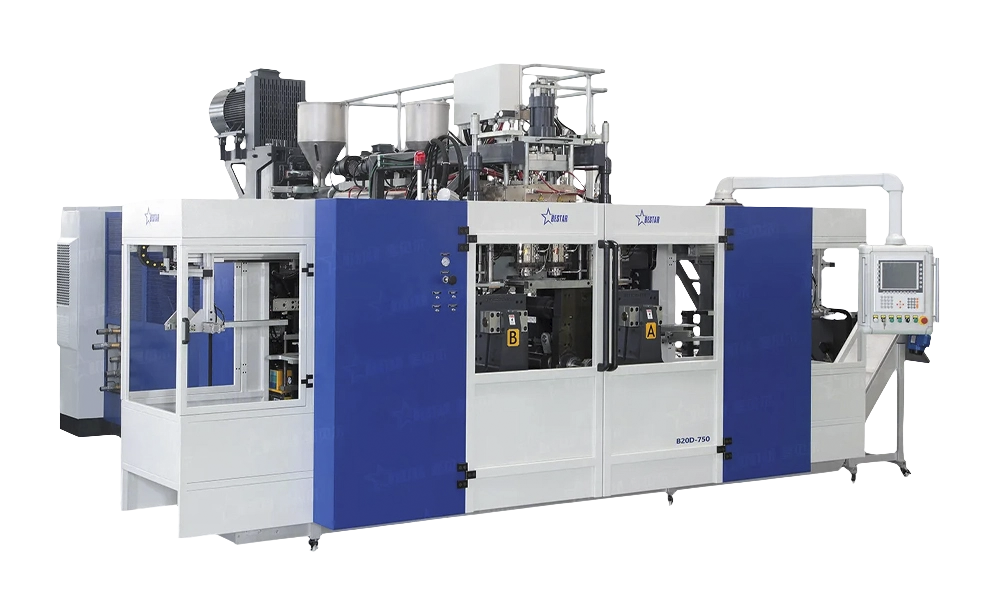
3. Two-Stage Blow Molding Machines
a. Working Principle
Two-stage blow molding separates the process into two distinct phases:
- Preform Production or Conditioning Stage: PET preforms are produced through injection molding or received from an external preform supplier. Preforms are stored and conditioned, ensuring uniform temperature distribution for optimal stretching.
- Blow Molding Stage: Preforms are loaded into a reheating oven, heated to the correct temperature, and then blown into the bottle mold using high-pressure air. The bottle is cooled and ejected.
This separation allows for higher automation and continuous operation, making two-stage machines ideal for large-scale production.
b. Advantages
- High Production Capacity: Two-stage machines can produce thousands of bottles per hour, making them suitable for industrial-scale operations.
- Energy Efficiency: Reheating preforms in bulk with optimized ovens reduces energy consumption per bottle.
- Improved Bottle Uniformity: Preform conditioning ensures even temperature distribution, resulting in consistent bottle wall thickness, strength, and clarity.
- Automation Friendly: Fully automated preform feeding, heating, and blowing minimize labor requirements and production downtime.
- Scalability: Easily integrated into high-volume production lines with fillers and cappers for a fully automated dairy operation.
c. Limitations
- Higher Initial Investment: Requires separate preform production or conditioning equipment and more extensive infrastructure.
- Larger Footprint: Two-stage setups require more floor space, including ovens and conveyors.
- Less Flexibility for Small Runs: Changing bottle designs may take longer, making it less suitable for frequent product changes.
Two-stage blow molding machines are ideal for large dairy companies, beverage manufacturers, and high-volume bottling operations, where efficiency, consistency, and scalability are priorities.
4. Key Differences Between Single-Stage and Two-Stage Machines
| Feature | Single-Stage Machine | Two-Stage Machine |
| Process Integration | Heating and blowing in one machine | Separate preform conditioning and blowing stages |
| Production Capacity | Moderate (suitable for small-medium runs) | High (industrial-scale production) |
| Initial Investment | Lower | Higher |
| Energy Efficiency | Less efficient | More efficient due to bulk preform heating |
| Automation Level | Semi-automatic or manual | Fully automatic |
| Flexibility | High; easy size changeover | Lower; more suitable for long production runs |
| Bottle Uniformity | Moderate; dependent on preform consistency | High; controlled preform conditioning ensures uniformity |
| Footprint | Compact | Larger; requires more space for ovens and conveyors |
| Labor Requirements | Higher due to manual operations | Lower; highly automated |
This table illustrates why production scale, budget, and operational flexibility are critical factors when choosing between the two machine types.
5. Factors to Consider When Choosing a Machine
- Production Volume: High-volume operations benefit from two-stage machines, while low to medium-volume producers may find single-stage machines sufficient.
- Capital Investment: Single-stage machines are less expensive and easier to set up. Two-stage machines require higher upfront investment but reduce long-term labor and energy costs.
- Bottle Design Variability: Single-stage machines are better for frequent size or shape changes.
- Energy Costs: Two-stage machines are more energy-efficient per bottle, which may reduce operational costs over time.
- Labor Availability: Highly automated two-stage machines reduce dependency on skilled operators.
- Space Availability: Single-stage machines are more compact, whereas two-stage setups require more floor space.
- Product Quality Requirements: If consistent wall thickness, clarity, and mechanical strength are critical, two-stage machines are preferred.
Evaluating these factors ensures that the selected machine aligns with production goals, cost structure, and operational constraints.
6. Applications in the Dairy Industry
Single-Stage Machines
- Suitable for small-scale dairy farms or artisanal milk producers.
- Ideal for producing limited runs of 1.5L milk bottles with occasional design variations.
- Beneficial for experimental products or seasonal production lines.
Two-Stage Machines
- Widely used by large dairy processors and beverage companies.
- Supports high-volume production, typically exceeding 10,000 bottles per hour.
- Ensures consistent bottle quality for automated filling, capping, and labeling systems.
- Preferred for export-oriented production due to stringent quality standards.
7. Maintenance and Operational Considerations
Both single-stage and two-stage machines require regular maintenance to ensure reliability:
- Heating Systems: Keep infrared heaters or ovens clean and calibrated for uniform temperature.
- Air Compressors: Ensure proper air pressure and dry air for consistent bottle blowing.
- Mechanical Components: Lubricate moving parts and check mold alignment regularly.
- Control Systems: Monitor sensors, PLCs, and automation controls for optimal performance.
Proper maintenance reduces downtime, enhances product quality, and extends machine lifespan, regardless of machine type.
8. Conclusion
Choosing between single-stage and two-stage blow molding machines for 1.5L milk bottles depends on several factors, including production volume, budget, automation requirements, space constraints, and product quality expectations.
- Single-Stage Machines: Offer flexibility, lower initial cost, and suitability for small- to medium-scale operations. They are ideal for producers who require frequent design changes or operate on a limited budget.
- Two-Stage Machines: Provide high-volume production, energy efficiency, consistent bottle quality, and full automation. They are optimal for large dairy processors and beverage companies focused on efficiency and scalability.
By understanding these differences, dairy producers and packaging engineers can make informed decisions to optimize production, maintain bottle quality, and reduce operational costs. Selecting the right machine ensures that 1.5L milk bottles are manufactured efficiently, safely, and with consistent performance, supporting both commercial and consumer needs.
