


 English


Introduction to PETG Blow Molding
What is PETG?
PETG (Polyethylene Terephthalate Glycol) is a type of thermoplastic polyester, known for its excellent clarity, ...
Content
- 1 Why Large-Volume Containers Require Specialized Blow Molding Equipment
- 2 Main Machine Types Used for 2L–10L Container Production
- 3 Key Technical Specifications for 2L–10L Blow Molding Machines
- 4 Materials Processed in 2L–10L Blow Molding
- 5 Mold Design Considerations for Large Containers
- 6 What to Evaluate When Buying a 2L–10L Blow Molding Machine
Large-volume container production in the 2-liter to 10-liter range presents a distinct set of engineering and process challenges that separate it clearly from small-bottle blow molding. The machines, tooling, materials, and process parameters required to produce a 5-liter water bottle, a 10-liter chemical container, or a 4-liter automotive fluid jug are fundamentally different from those used to make 500ml beverage bottles. If you are evaluating blow molding equipment for large containers — whether for water, edible oil, detergent, chemicals, lubricants, or agricultural products — understanding how the major machine types work, what specifications determine their suitability for your application, and what practical factors affect production efficiency and product quality will significantly improve the quality of your purchasing decision.
Why Large-Volume Containers Require Specialized Blow Molding Equipment
The physics of blow molding change significantly as container volume increases. A 10-liter container has roughly 20 times the volume of a 500ml bottle, but the wall surface area increases by only a factor of 6–8. This means the average wall thickness of a large container is greater in absolute terms, requiring more material per unit and more energy to heat, extrude, and form. The parison — the molten plastic tube from which the bottle is blown — must be substantially heavier and longer than for a small bottle, placing higher demands on the extruder, accumulator head, and mold clamping system.
Wall thickness distribution is a more critical challenge in large containers than small ones. In a 10-liter container with complex geometry, the parison stretches unevenly during blowing — areas near the mold parting line stretch less than areas farthest from the blow pin. Without active parison programming to compensate for these variations, the finished container will have thin areas near the mold extremities and excessively thick areas near the pinch-off zones. Thin areas reduce structural integrity and may cause failure during drop testing or stacking. Thick areas waste material and increase per-unit cost. Large-container blow molding machines therefore incorporate parison programming systems — typically with 32 to 128 or more programmable points — that continuously vary the die gap during extrusion to pre-compensate for the differential stretching that occurs during blowing.
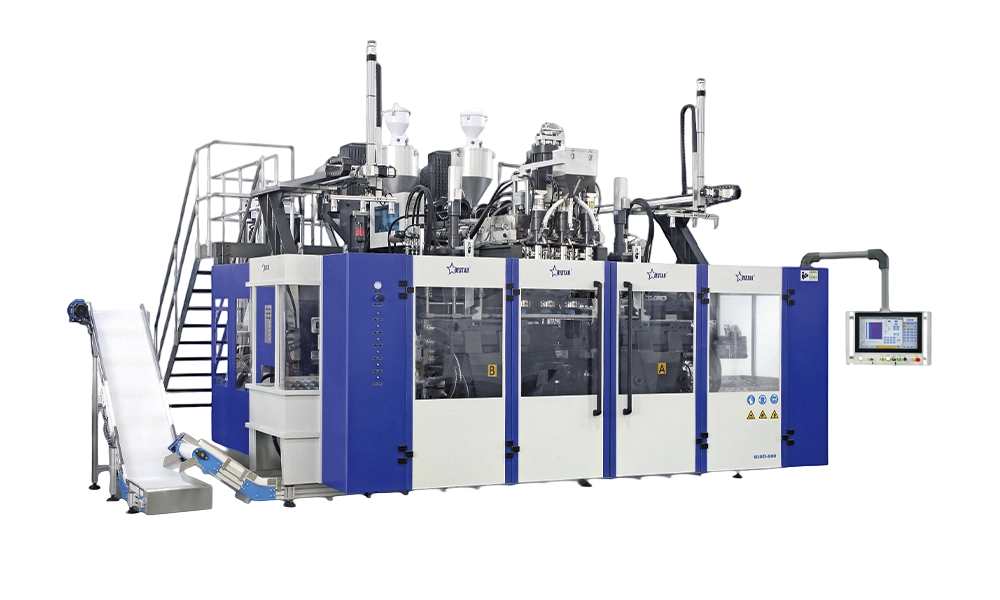
Mold clamping forces are also substantially higher for large containers. The total blowing pressure acting on the mold halves is proportional to the projected area of the container, and a 10-liter container with a large projected area may require clamping forces of 100–300 kN or more to hold the mold closed during blowing. This drives up the structural requirements for the platen, tie bars, and clamp mechanism, making large-container blow molding machines significantly heavier and more expensive than small-container equivalents.
Main Machine Types Used for 2L–10L Container Production
Continuous Extrusion Blow Molding Machines
Continuous extrusion blow molding is the most widely used process for large container production in the 2–10 liter range. In this process, a screw extruder continuously melts and pushes plastic through an annular die head to produce a continuous tube of molten plastic (the parison). The mold halves close around the parison, a blow pin is inserted, and compressed air inflates the parison against the mold cavity. After the part has cooled sufficiently to hold its shape, the mold opens, the container is ejected, and the cycle repeats.
For large containers where cycle times are long — typically 15–45 seconds for 5–10 liter containers depending on wall thickness and cooling efficiency — shuttle machines or rotary machines are used to keep the extruder running continuously while the molds are closing, blowing, and cooling. In a shuttle machine, two mold stations alternate — one is in the blowing and cooling phase while the other is moving into position to receive the next parison drop. In a rotary machine (wheel machine), multiple mold stations are mounted on a rotating carousel and each completes a full cycle per revolution, allowing the extruder to run at a steady rate matched to the total cycle time of all molds combined.
Accumulator Head Blow Molding Machines
For the largest containers in the 5–10 liter range — particularly those with heavy wall sections, handled containers, or complex geometry — accumulator head blow molding is often the preferred process. In an accumulator machine, the extruder fills an accumulator chamber (a hydraulic accumulator or ring accumulator) with molten plastic during the mold cooling phase. When the mold opens and is ready for the next parison, the accumulator hydraulically pushes the stored melt through the die head in a single rapid shot, producing the entire parison in a fraction of a second. This rapid parison drop is essential for large, heavy parisons that would sag excessively if extruded slowly, causing uneven wall distribution in the blown container.
Accumulator head machines provide precise control over parison weight and length, and the hydraulic shot mechanism is compatible with multi-point parison programming systems that adjust the die gap profile during the shot to optimize wall thickness distribution. They are commonly used for producing 5–10 liter HDPE containers for chemicals, agricultural products, and industrial fluids where container wall uniformity, top-load strength, and drop resistance are critical performance requirements.
Stretch Blow Molding Machines for PET Large Containers
While most large containers in the 2–10 liter range are produced from HDPE or PP by extrusion blow molding, PET is used for large-volume water bottles (typically 3–10 liters) and edible oil containers where clarity, barrier properties, and consumer appeal are priorities. PET large containers are produced by injection stretch blow molding (ISBM) or reheat stretch blow molding (RSBM), using a preform that is injection-molded separately and then conditioned to the correct temperature before being stretch-blown in a two-stage process.
Producing PET containers above 5 liters requires specialized large-format ISBM or RSBM machines with extended stretch rod travel, high-pressure blowing capability (typically 35–40 bar), and mold configurations designed for the greater preform conditioning uniformity challenges that arise with the heavier preforms required for large containers. The material investment in large PET preforms is substantial, and preform design — particularly the distribution of material in the preform body relative to the desired wall distribution in the blown container — requires careful engineering to achieve acceptable material distribution in 5–10 liter PET containers.
Key Technical Specifications for 2L–10L Blow Molding Machines
| Specification | Typical Range (2L–10L EBM) | Why It Matters |
| Max container volume | 2L – 10L (machine-specific) | Must cover your full product range |
| Extruder screw diameter | 60 mm – 120 mm | Determines melt output rate and material throughput |
| Clamping force | 80 kN – 400 kN | Must exceed blowing force on largest container projected area |
| Parison programming points | 32 – 256 points | More points = finer wall thickness distribution control |
| Blowing pressure | 4 – 10 bar (EBM); 35–40 bar (ISBM PET) | Must fully form container against mold at all wall thicknesses |
| Output rate (bottles/hour) | 100 – 600 bottles/hr (size dependent) | Must match your production volume requirements |
| Compatible materials | HDPE, PP, PVC, PET (machine dependent) | Must support materials required for your container applications |
| Mold cooling system | Water-cooled, chilled water circuit | Cooling efficiency directly affects cycle time and output |
Materials Processed in 2L–10L Blow Molding
The choice of resin for large containers depends on the intended contents, regulatory requirements, end-user handling expectations, and economics. Each major resin type has specific processing requirements that the blow molding machine must accommodate.
- HDPE (High-Density Polyethylene): The dominant material for large containers across industrial chemicals, agricultural chemicals, lubricants, water, and food products. HDPE offers excellent chemical resistance, good impact strength, food-contact compliance, and processability on standard extrusion blow molding equipment. It is the material of first choice for most 2–10 liter container applications and the baseline around which most large-container EBM machines are designed.
- PP (Polypropylene): Used for containers requiring higher temperature resistance — automotive fluids, hot-fill products, and containers sterilized after filling. PP has lower density than HDPE (lighter containers for the same volume), good chemical resistance, and is steam-sterilizable. It requires higher melt temperatures and more precise process control than HDPE and tends to produce containers with slightly lower impact resistance at low temperatures.
- PET (Polyethylene Terephthalate): Used for large water bottles, edible oil containers, and premium food packaging where clarity, gas barrier properties, and consumer aesthetics are important. PET requires the injection stretch blow molding process rather than extrusion blow molding and demands more sophisticated and expensive machinery, but produces containers with superior optical clarity and significantly better oxygen and CO₂ barrier properties than polyolefins.
- PVC (Polyvinyl Chloride): Still used for certain chemical containers and specialty applications, though declining in new container designs due to regulatory restrictions on PVC in food-contact and medical applications and end-of-life recycling challenges. PVC blow molding requires specific screw and barrel metallurgy to resist the corrosive effects of HCl generated during PVC thermal degradation, and processing temperatures must be carefully controlled to avoid decomposition.
Mold Design Considerations for Large Containers
The mold is the most expensive single tooling investment in a large-container blow molding operation, and mold design decisions made at the outset significantly affect container quality, cycle time, material efficiency, and production flexibility. For 2–10 liter containers, molds are typically machined from aluminum alloy (for faster heat transfer and lower tooling cost) or beryllium-copper alloy (for maximum cooling efficiency in high-output applications), with steel inserts at wear points such as the pinch-off area and handle formation zones.
Cooling channel design within the mold is critical for large containers. The mold cooling system must extract the heat stored in the heavy wall sections of a large container rapidly and uniformly to minimize cycle time without creating differential cooling that warps the container. Conformal cooling channels — which follow the contour of the mold cavity rather than running in straight drillings — are used in premium large-container molds to achieve more uniform cooling across the entire cavity surface. The chilled water temperature, flow rate, and channel circuit design collectively determine the minimum achievable cycle time, which directly drives hourly output and per-unit production cost.
Handle integration is a design challenge specific to large containers. A 5-liter or 10-liter container filled with liquid weighs 5–10 kg, and consumers require a robust handle to carry and pour the product. Integrated handles — formed by the blow molding process itself, where the parison bridges across a handle recess in the mold — are stronger and more economical than separately molded and assembled handles. Producing a well-defined, fully formed integrated handle on a large container requires careful parison programming to ensure sufficient material at the handle location and adequate blowing pressure to fully form the handle geometry against the mold surface.
What to Evaluate When Buying a 2L–10L Blow Molding Machine
For buyers comparing machines in this category, the following practical evaluation criteria go beyond headline specifications and address the factors that most directly affect production performance and total cost of ownership over the machine's service life:
- Parison programming capability and repeatability: Request demonstration data showing wall thickness distribution across the container from top to bottom and around the circumference, achieved with the machine's parison programming system on a container representative of your product geometry. Repeatability — how consistently the machine reproduces the programmed parison profile from cycle to cycle and shift to shift — is as important as the maximum number of programmable points.
- Extruder performance and melt quality: For HDPE large containers, melt temperature uniformity across the die cross-section and freedom from gels and degraded material are critical for container appearance and mechanical properties. Request information on extruder L/D ratio, mixing section design, and melt temperature consistency data. Machines with short, poor-mixing extruders produce melt with temperature gradients that create streaks and weak spots in blown containers.
- Cycle time verification on your target container: Headline cycle time figures from machine manufacturers are typically measured on optimal conditions with a specific container and material. Request a trial run on a container representative of your application, and measure actual cycle time including all non-productive time (mold open, parison drop, mold close, ejection). The difference between claimed and actual cycle time can be 20–40% on complex large containers.
- Energy consumption per unit: Large-container blow molding machines are significant energy consumers — extruder motors, hydraulic systems, chiller units, and heater bands all contribute. Energy consumption per 1,000 containers produced is a meaningful comparison metric that affects operating cost. Modern servo-hydraulic and all-electric drive systems can reduce energy consumption by 30–50% compared to conventional hydraulic machines, which may justify the higher initial investment over a machine's 15–20 year service life.
- After-sales support and spare parts availability: A large-container blow molding machine running three shifts per day generates revenue that makes downtime extremely costly. Confirm the supplier's service response capability in your region, the availability of critical spare parts (extruder screw and barrel, hydraulic seals, parison programming actuators), and the supplier's track record of supporting machines over their operating life.
