


 English


Introduction to PETG Blow Molding
What is PETG?
PETG (Polyethylene Terephthalate Glycol) is a type of thermoplastic polyester, known for its excellent clarity, ...
Content
- 1 How Blow Molding Works for Milk Bottle Production
- 2 Machine Types for 1.5L Milk Bottle Production
- 3 Key Technical Specifications to Evaluate
- 4 Material Requirements for Food-Grade Milk Bottles
- 5 Mold Design Considerations for 1.5L Milk Bottles
- 6 Control Systems and Automation in Modern Blow Molding Machines
- 7 Output Rate Planning and Production Capacity Matching
- 8 Practical Selection Criteria for Buyers
The 1.5L milk bottle blow molding machine occupies a precise and commercially significant niche within the broader plastic bottle manufacturing industry. Dairy producers, juice manufacturers, and food-grade beverage bottlers worldwide rely on this category of equipment to produce the high-density polyethylene (HDPE) or polypropylene (PP) bottles that dominate the fresh milk, flavored milk, and dairy beverage retail market. Unlike PET bottles used for carbonated drinks and water, milk bottles require a specific combination of opacity, rigidity, food-contact compliance, and compatibility with cold-chain distribution — characteristics that are determined by both the resin selected and the blow molding process used to form the bottle. Selecting, specifying, and operating the right 1.5L milk bottle blow molding machine has direct consequences for production efficiency, bottle quality consistency, material consumption, and the total cost per unit across a dairy packaging operation's service life.
How Blow Molding Works for Milk Bottle Production
Blow molding is a manufacturing process in which a hollow tube of molten plastic — called a parison — is formed and then inflated inside a closed mold cavity to produce a hollow bottle or container shape. For milk bottle production, the dominant process is extrusion blow molding (EBM), which is particularly well suited to HDPE — the material of choice for opaque milk bottles globally. In the EBM process, HDPE granules are fed into a heated extruder screw barrel that melts and homogenizes the material before forcing it through an annular die head to form a continuous tubular parison. The parison is captured between the two halves of a closing bottle mold, a blow pin is inserted into the parison opening, and compressed air is introduced to inflate the parison against the cooled mold cavity walls. The HDPE solidifies rapidly against the cold mold surface, the mold opens, and the finished bottle is ejected — complete with its neck and threads — within a cycle time of typically 8–20 seconds depending on bottle wall thickness, mold cooling efficiency, and machine configuration.
Injection stretch blow molding (ISBM) and injection blow molding (IBM) are used for some milk bottle applications — particularly in markets where transparent or semi-transparent PP milk bottles are preferred — but extrusion blow molding dominates the global HDPE milk bottle market because of its cost efficiency, tooling simplicity, and ability to produce bottles with handles, complex shoulder geometries, and varying wall thickness distributions that are difficult or impossible to achieve in injection blow molding at comparable cost. The 1.5L format specifically benefits from the EBM process's ability to produce the relatively thick wall sections and integrated handle features common in this size category without the tooling complexity and higher unit cost of injection-based processes.
Machine Types for 1.5L Milk Bottle Production
Within the extrusion blow molding category, several machine configurations are available for 1.5L milk bottle production, each offering different trade-offs between output rate, mold investment, floor space, and flexibility for product changeover.
Single-Station Continuous Extrusion Blow Molding Machines
Single-station continuous extrusion machines use a single extruder and die head to produce a continuously extruded parison, with the mold closing, blowing, and opening operations occurring in sequence at a single station. These machines are mechanically straightforward, lower in capital cost, and easier to maintain than multi-station alternatives. They are most appropriate for lower-volume production runs, smaller operations with multiple product changeovers per day, and applications where the 1.5L bottle is one of several formats produced on the same machine. The output rate of single-station machines for 1.5L bottles typically ranges from 200 to 600 bottles per hour per cavity, depending on cycle time and machine size.
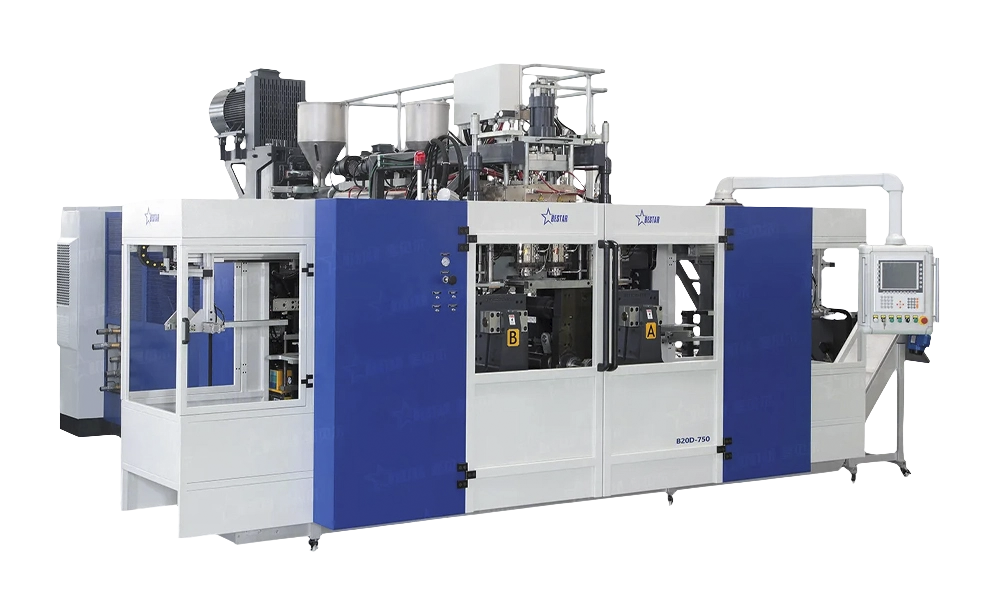
Multi-Head and Multi-Cavity Extrusion Blow Molding Machines
Multi-head machines use multiple extruder heads feeding multiple mold stations simultaneously, or a single large head feeding a mold with multiple cavities, to multiply the output rate proportionally to the number of heads or cavities. For high-volume dairy bottling operations where 1.5L bottles represent a dominant SKU produced in continuous runs, multi-cavity machines with two, four, or six cavities per mold deliver substantially higher output per machine footprint and per operator than single-cavity alternatives. A four-cavity 1.5L milk bottle machine operating at 12-second cycle time produces approximately 1,200 bottles per hour — a throughput level appropriate for a medium-scale dairy bottling line producing 20,000–30,000 bottles per shift.
Rotary Wheel Blow Molding Machines
Rotary wheel machines use a carousel of molds mounted on a rotating wheel, with each mold station receiving a parison, blowing, cooling, and ejecting in sequence as the wheel rotates continuously. This configuration achieves very high output rates by maximizing mold utilization — each mold is always performing one of the process steps while others simultaneously perform the remaining steps — and is the configuration of choice for the highest-volume milk bottle production facilities targeting outputs of 5,000–15,000 bottles per hour. The capital cost of rotary wheel machines is substantially higher than linear shuttle machines, but the output per square meter of floor space and per unit of labor is correspondingly greater, making them the most cost-efficient choice at high production volumes.
Key Technical Specifications to Evaluate
Selecting a 1.5L milk bottle blow molding machine requires systematic evaluation of technical specifications that together determine whether the machine can meet production targets with acceptable bottle quality and operating costs. The following table summarizes the most important parameters and their significance.
| Specification | Typical Range | Why It Matters |
| Output Rate (bottles/hour) | 400 – 15,000+ | Determines production capacity and line sizing |
| Extruder Screw Diameter | 60 – 120 mm | Determines melt output capacity and plasticizing rate |
| Clamping Force | 20 – 150 kN | Must exceed mold separation force during blowing |
| Blow Air Pressure | 4 – 8 bar | Affects bottle surface definition and wall distribution |
| Number of Cavities | 1 – 6 (linear), up to 24 (rotary) | Directly multiplies output per machine |
| Parison Wall Thickness Control | PWDS or FPDS system | Controls bottle wall thickness uniformity |
| Installed Motor Power | 15 – 90 kW | Impacts operating energy cost per bottle |
| Mold Cooling System | Water-cooled, chilled water | Cycle time and bottle dimensional stability |
Parison wall thickness distribution control — achieved through parison wall thickness distribution systems (PWDS) or full parison die systems (FPDS) that servo-adjust the die gap during parison extrusion — is particularly critical for 1.5L milk bottles, which have significantly varying wall thickness requirements across different bottle zones. The base, shoulder, and body sections of a 1.5L bottle require different wall thicknesses to optimize structural performance, material consumption, and bottle weight. Without active parison thickness control, the natural stretching behavior of the parison during inflation tends to thin the corners and shoulder areas while leaving excessive material at the bottle base and neck — producing bottles that are simultaneously over-weight and structurally weak in critical areas.
Material Requirements for Food-Grade Milk Bottles
The material specification for 1.5L milk bottles is tightly governed by food contact safety regulations, functional performance requirements, and the physical demands of dairy supply chain logistics. HDPE — specifically grades with melt flow index (MFI) values in the range of 0.3–0.8 g/10 min — is the overwhelmingly dominant choice for opaque milk bottle production worldwide, selected for its combination of food-contact regulatory compliance, opacity that protects milk from UV-induced flavor degradation, rigidity at refrigeration temperatures, compatibility with high-speed filling equipment, and complete recyclability in established HDPE recycling streams.
The blow molding machine must be configured to process HDPE at the appropriate melt temperature — typically 180–230°C in the extruder barrel — with a screw design specifically optimized for HDPE's relatively narrow processing window and sensitivity to thermal degradation from excessive residence time at processing temperatures. Machines specified for PET processing are not appropriate for HDPE milk bottle production because PET requires drying to very low moisture content, operates at significantly higher processing temperatures, and uses a stretch blow molding process fundamentally different from the extrusion blow molding used for HDPE. When evaluating machines, confirm that the extruder screw geometry, barrel temperatures, and die head design are specifically configured for the HDPE grades intended for production rather than being generic configurations claimed to handle multiple material types without optimization for any specific resin.
Mold Design Considerations for 1.5L Milk Bottles
The mold for a 1.5L milk bottle is not simply a negative of the bottle shape — it is a precision engineering assembly that controls bottle geometry, surface finish, neck dimensions, base stability, and cooling rate, all of which directly affect bottle quality and production efficiency. Understanding the key mold design variables helps in evaluating mold quotations and specifying the right tooling for a new machine investment.
- Mold material and cooling circuit design: High-quality milk bottle molds use aluminum alloy cavities — typically 7075 or similar aerospace-grade alloys — that conduct heat away from the solidifying HDPE approximately four times faster than steel, enabling shorter cycle times without compromising bottle dimensional stability. The cooling water circuit within the mold must be designed to achieve uniform temperature distribution across the entire cavity surface — hot spots in the mold produce locally thinner, less stable bottle walls and extend effective cycle time by preventing complete solidification before mold opening.
- Pinch-off geometry: The pinch-off — where the mold halves compress and seal the parison at the bottle base and neck flash areas — must be precision machined to produce a clean, strong weld line that passes bottle drop test and top load performance requirements. A poorly designed or worn pinch-off produces a weak base weld that fails under the hydrostatic pressure of a filled bottle or the compressive load of stacked shipping cases, resulting in leakage and product returns.
- Neck finish calibration: The neck thread and sealing surface dimensions of the 1.5L milk bottle must be held to close tolerances to ensure reliable closure application and consistent leak-free sealing throughout the distribution chain. The neck calibration tooling in the mold — including the blow pin, calibration ring, and neck inserts — must be dimensionally stable and wear-resistant, as neck dimension drift from tooling wear is a common source of closure application problems in high-volume milk bottle production.
- Handle integration: Many 1.5L milk bottle formats include an integrated handle that requires specific mold geometry and parison programming to achieve consistent wall thickness in the handle area and around the handle connection points. The handle geometry also affects the mold's clamp force requirements and mold opening stroke, and must be designed in coordination with the machine's mold platen dimensions and opening stroke specification.
Control Systems and Automation in Modern Blow Molding Machines
Modern 1.5L milk bottle blow molding machines are equipped with sophisticated PLC-based control systems that manage and monitor every process parameter in real time, enabling consistent bottle quality production across extended production runs with minimal operator intervention. The sophistication of the control system is a meaningful differentiator between machine suppliers and has direct implications for bottle quality consistency, scrap rate, and the skill level required of machine operators.
Core control functions in a quality blow molding machine for milk bottle production include closed-loop extruder barrel temperature control across multiple heating zones, servo-controlled parison wall thickness programming with up to 100 or more thickness variation points per parison, mold clamping force monitoring, blow air pressure and time control, and automated flash removal and bottle rejection systems. Advanced machines incorporate vision-system quality inspection that checks every produced bottle for dimensional compliance, surface defects, and wall thickness — automatically rejecting non-conforming bottles before they enter the downstream conveying and labeling systems. Recipe management — the ability to store and instantly recall complete process parameter sets for each bottle format — is essential for operations producing multiple bottle sizes and designs on the same machine, enabling fast, repeatable changeovers that minimize production downtime between format runs.
Output Rate Planning and Production Capacity Matching
Matching the blow molding machine's output rate to the dairy bottling line's filling and packaging capacity is critical for achieving balanced line efficiency. A machine that produces bottles faster than the filler can process them creates a buffer management problem and floor space requirement for bottle accumulation. A machine that cannot keep pace with filler demand becomes the line bottleneck, limiting overall line output regardless of filler capacity.
- Calculate required output rate accurately: Determine the net bottle output required per hour based on filler capacity, planned operational efficiency (typically 85–92% for a well-maintained dairy bottling line), and any buffer accumulation capacity between the blow molder and filler. Add 15–20% to the net requirement to select a machine rated output that accommodates planned maintenance downtime without creating a production shortfall.
- Consider future capacity growth: If production volumes are expected to grow significantly within the machine's service life — typically 15–20 years for a quality blow molding machine — evaluate whether the selected machine can be upgraded with additional cavities, a faster operating cycle, or a second extruder head to grow capacity without a full machine replacement investment. Modular machine designs that support these upgrades provide lower-risk capacity growth pathways than fixed-configuration alternatives.
- Evaluate energy efficiency at operating output: Blow molding machines consume significant electrical energy in the extruder motor, hydraulic clamping system, and cooling water system. Modern servo-hydraulic and all-electric machine designs reduce energy consumption by 20–40% compared to conventional hydraulic machines of equivalent output, with payback periods that can be calculated based on local electricity rates and the machine's expected annual operating hours. For a machine running three shifts per day, 300+ days per year, energy efficiency is a major component of total operating cost per bottle.
Practical Selection Criteria for Buyers
The selection of a 1.5L milk bottle blow molding machine is a capital investment decision that will affect production operations for 15–20 years and must be made with careful attention to a broad set of technical, commercial, and operational criteria beyond the machine's headline output rate and price.
- Supplier application experience in dairy packaging: Prioritize machine suppliers with documented experience supplying blow molding equipment to dairy bottling operations, ideally with reference installations producing 1.5L HDPE milk bottles that can be visited or contacted for performance verification. Dairy bottle production has specific requirements — food-contact material compliance, hygienic machine design, integration with downstream conveying and filling systems — that general-purpose blow molding machine suppliers may not have addressed in their standard machine designs.
- Spare parts availability and local service support: A blow molding machine that suffers a critical component failure and waits two weeks for spare parts from an overseas supplier loses more production value in that downtime than the cost saving from selecting a cheaper machine with poor local support. Evaluate the supplier's spare parts inventory in your region, their service engineer response time commitment, and the availability of critical wear parts — extruder screws and barrels, die heads, hydraulic seals, and control system components — from local stock before committing to a supplier.
- Factory acceptance testing protocol: Require a factory acceptance test (FAT) at the machine supplier's facility before shipment, with the actual production mold installed and running at the specified output rate and bottle quality targets using the specified HDPE grade. The FAT should demonstrate compliance with agreed bottle weight, wall thickness distribution, top load, and drop test specifications across a minimum production run of several hundred bottles — not just a brief demonstration run that may not reveal process stability issues that emerge over extended production.
- Total cost of ownership analysis: Calculate the total cost of ownership over the machine's expected service life including purchase price, installation and commissioning cost, annual energy consumption cost, maintenance and spare parts cost, operator labor cost, and scrap rate cost. A machine with 15% lower purchase price but 30% higher energy consumption, twice the scrap rate, and higher maintenance costs will deliver significantly higher total cost over a 15-year service life than a higher-quality alternative — and this calculation should be made explicitly before supplier selection rather than defaulting to lowest initial price as the primary decision criterion.
