


 English


Introduction to PETG Blow Molding
What is PETG?
PETG (Polyethylene Terephthalate Glycol) is a type of thermoplastic polyester, known for its excellent clarity, ...
Content
- 1 1. Importance of Choosing the Right Plastic Material
- 2 2. High-Density Polyethylene (HDPE)
- 3 3. Linear Low-Density Polyethylene (LLDPE)
- 4 4. Polypropylene (PP)
- 5 5. Polyvinyl Chloride (PVC)
- 6 6. Polyethylene Terephthalate (PET)
- 7 7. Multilayer (Co-extruded) Materials
- 8 8. Material Selection Considerations
- 9 Conclusion
In the chemical packaging industry, the durability, chemical resistance, and safety of storage containers are of paramount importance. Chemical barrel bottle blow molding machines play a crucial role in manufacturing high-quality containers designed to store and transport aggressive or sensitive substances safely. The type of plastic material used in these machines determines not only the performance of the final product but also its compliance with industry standards for chemical compatibility and mechanical strength. This article explores the main plastic materials suitable for chemical barrel bottle blow molding machines, their properties, and their applications.
1. Importance of Choosing the Right Plastic Material
Blow molding is a process that forms hollow plastic parts, such as bottles, containers, and barrels, by inflating a heated plastic tube until it fills a mold cavity. For chemical barrel production, the selected material must meet strict criteria, including:
- Chemical resistance: The ability to withstand acids, alkalis, solvents, and other corrosive substances without degrading.
- Mechanical strength: High impact resistance and rigidity to endure handling and transportation.
- Environmental stability: Resistance to UV rays, oxidation, and temperature changes.
- Processability: The material should melt, flow, and cool efficiently in the blow molding process.
The wrong material can result in leaks, deformation, or chemical reactions with stored substances, leading to safety hazards and economic loss. Therefore, manufacturers must carefully select resins with the right balance of strength, stability, and resistance.
2. High-Density Polyethylene (HDPE)
HDPE is the most widely used plastic material for chemical barrel and drum production. It is favored for its excellent balance of strength, flexibility, and chemical resistance.
Key properties of HDPE:
- Outstanding resistance to acids, alcohols, bases, and many solvents.
- High tensile strength and impact resistance.
- Lightweight yet durable structure.
- Excellent processability in extrusion blow molding.
- Good environmental stress-crack resistance (ESCR).
Applications:
HDPE barrels are ideal for storing and transporting industrial chemicals, agricultural fertilizers, detergents, and petroleum-based liquids. The material’s high molecular weight grades are especially used for large-capacity containers (100L–200L) that must resist impact and rough handling.
Advantages in blow molding:
HDPE’s low moisture absorption and stable melt flow make it easy to form uniform wall thickness during molding. It also cools rapidly, increasing production efficiency.
3. Linear Low-Density Polyethylene (LLDPE)
LLDPE is another popular resin used for chemical containers where flexibility and toughness are required. Compared with HDPE, LLDPE provides better resistance to cracking and puncturing but slightly lower stiffness.
Key properties of LLDPE:
- Excellent impact resistance, even at low temperatures.
- Good chemical and stress-crack resistance.
- Better elongation and flexibility compared to HDPE.
- Compatible with multilayer co-extrusion for enhanced barrier protection.
Applications:
LLDPE is often used for smaller barrels, canisters, and containers that need higher flexibility or must withstand impact during shipping. It is also used in combination with HDPE in multilayer blow molding to improve container performance.
4. Polypropylene (PP)
Polypropylene offers higher temperature resistance than polyethylene materials and is ideal for storing chemicals that are filled or used at elevated temperatures.
Key properties of PP:
- Excellent resistance to acids, alkalis, and organic solvents.
- High melting point (~160°C) suitable for hot filling.
- Rigid structure with good dimensional stability.
- Lightweight with a glossy surface finish.
Applications:
PP is used to produce containers for strong acids, cleaning agents, and chemicals that may cause swelling in polyethylene-based containers. It is also used for applications requiring high clarity or stiffness, such as laboratory bottles and specialized chemical packaging.
Limitations:
PP is more brittle at low temperatures and less impact-resistant than HDPE, making it less suitable for very large barrels or rough handling conditions.
5. Polyvinyl Chloride (PVC)
PVC was once a common material in chemical container production, particularly for smaller bottles and rigid containers. However, its use has decreased due to environmental concerns and processing challenges.
Key properties of PVC:
- Excellent resistance to acids, alkalis, and salts.
- High rigidity and dimensional stability.
- Flame retardant and self-extinguishing nature.
Applications:
PVC is still used for specific chemical bottles, laboratory reagents, and smaller industrial packaging applications where rigidity and clarity are required.
Limitations:
PVC can degrade under high temperatures during processing, releasing hydrochloric acid gas. Therefore, stabilizers and processing aids are needed. It is also less flexible compared to polyolefins like HDPE or LLDPE.
6. Polyethylene Terephthalate (PET)
PET is well known for its use in beverage and food packaging but also finds applications in certain chemical containers. It offers superior clarity and gas barrier properties.
Key properties of PET:
- High strength and rigidity.
- Good chemical resistance against weak acids and bases.
- Excellent transparency for visible product inspection.
- Strong resistance to gas permeation and moisture absorption.
Applications:
PET is used for packaging household and laboratory chemicals, such as cleaners, detergents, and solvents. However, it is not suitable for strong acids or caustic substances, which may cause hydrolysis or chemical degradation.
7. Multilayer (Co-extruded) Materials
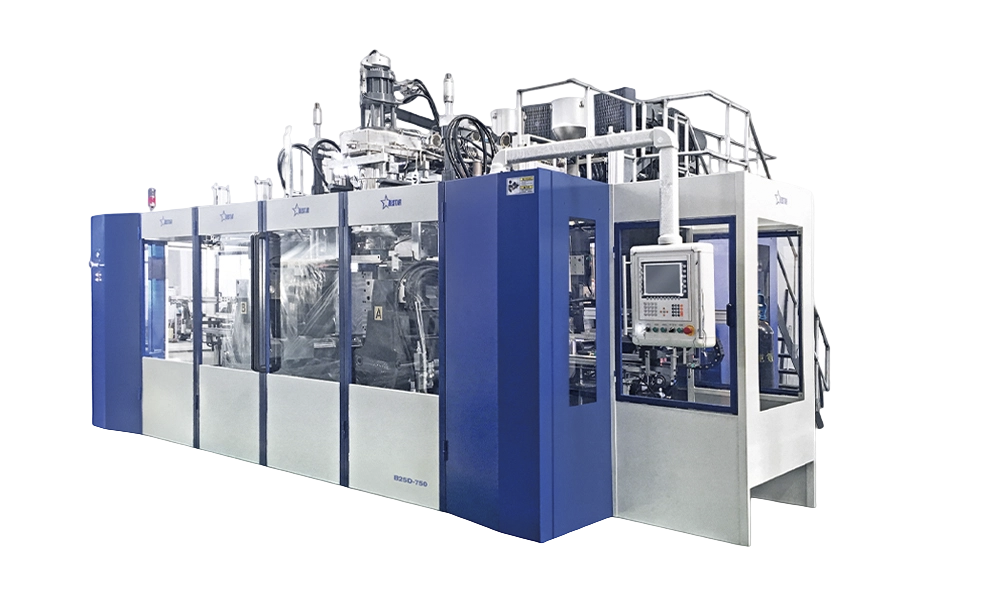
Modern chemical barrel bottle blow molding machines increasingly use multilayer co-extrusion technology. This approach combines multiple materials to enhance container properties.
A typical multilayer structure might include:
- Inner layer: HDPE or LLDPE for chemical resistance.
- Barrier layer: EVOH (ethylene-vinyl alcohol) or PA (nylon) to prevent gas permeation.
- Outer layer: Recycled HDPE or UV-stabilized polyethylene for strength and protection.
Advantages of multilayer structures:
- Improved chemical and gas barrier performance.
- Extended shelf life for volatile or reactive chemicals.
- Potential for cost reduction by incorporating recycled materials.
Multilayer blow molding allows manufacturers to tailor material properties precisely to product requirements while maintaining safety and sustainability.
8. Material Selection Considerations
When selecting materials for chemical barrel blow molding, manufacturers must consider:
- Chemical compatibility: Resistance to the specific substance stored.
- Temperature range: Conditions during filling, storage, and transport.
- Impact and load requirements: Barrel size and expected handling stress.
- Environmental regulations: Recyclability and compliance with FDA, UN, or ISO standards.
- Processing efficiency: Melt flow index (MFI) and cooling characteristics for high productivity.
Choosing the correct material not only ensures product safety but also reduces production costs and environmental impact.
Conclusion
The selection of plastic materials for chemical barrel bottle blow molding machines is a critical decision that affects product safety, durability, and performance. HDPE remains the dominant choice due to its excellent chemical resistance and mechanical strength. However, other materials like LLDPE, PP, PET, and multilayer composites provide specialized advantages depending on the application.
As industries move toward greener and more efficient packaging solutions, the future of chemical barrel production lies in advanced material engineering — integrating recyclability, barrier performance, and energy efficiency. By understanding the properties and suitability of different plastics, manufacturers can produce containers that meet modern safety, environmental, and performance standards while optimizing production with state-of-the-art blow molding technologies.
